

 English
 日本語
日本語 русский


Bottom Entry Mixer vs Side Entry Mixer: Which One Should You Choose?
Content
- 1 Quick Comparison: Bottom Entry Mixer vs Side Entry Mixer
- 2 What Is a Bottom-Entry Mixer (Bottom Feed Mixer) and How Does It Work
- 3 What Is a Side Entry Mixer
- 4 Bottom Entry Mixer vs Side Entry Mixer: Feature Comparison Table
- 5 Performance Characteristics Compared
- 6 Bottom-Entry Mixer Structure Explained
- 7 Where Bottom Entry Mixers and Side Entry Mixers Are Used
- 8 Viscosity, Solids Suspension, and Batch Size Considerations
- 9 Cleaning and Maintenance Differences
- 10 How to Choose Between a Bottom Entry Mixer and a Side Entry Mixer
- 11 About Wuxi Top Mixer Equipment: A Bottom Entry Mixer Manufacturer
- 12 Frequently Asked Questions
Quick Comparison: Bottom Entry Mixer vs Side Entry Mixer
A bottom entry mixer is generally the stronger option when a process needs gentle, low-shear blending in a small to mid-size vessel, especially where hygienic design and easy cleaning matter, such as dairy processing, cosmetics formulation, and biotechnology batches. A side entry mixer is typically the better fit for large storage tanks and bulk liquid vessels, where the unit is mounted through the tank side wall near the bottom to keep solids suspended and blend large volumes without opening the tank roof. The right choice depends on tank size, product viscosity, hygiene requirements, and how the vessel is accessed for service.
Before going deeper into design details, here is a short summary of when each configuration tends to make sense in day to day plant operations.
- Choose a bottom-entry mixer for low to medium viscosity liquids in vessels that need frequent cleaning or sanitary handling.
- Choose a side entry mixer for large diameter storage tanks where top access is limited or impractical.
- Consider tank floor space, headroom, and seal maintenance access before finalizing either configuration.
- Both configurations can help keep solids suspended, but the ideal impeller and mounting angle depend on the specific batch and tank geometry.
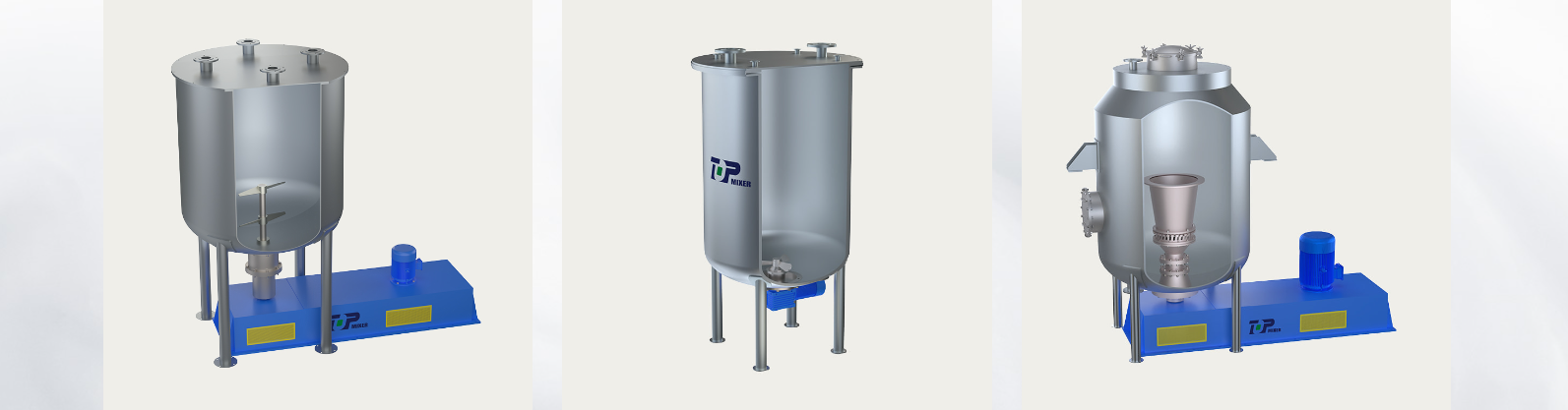
What Is a Bottom-Entry Mixer (Bottom Feed Mixer) and How Does It Work
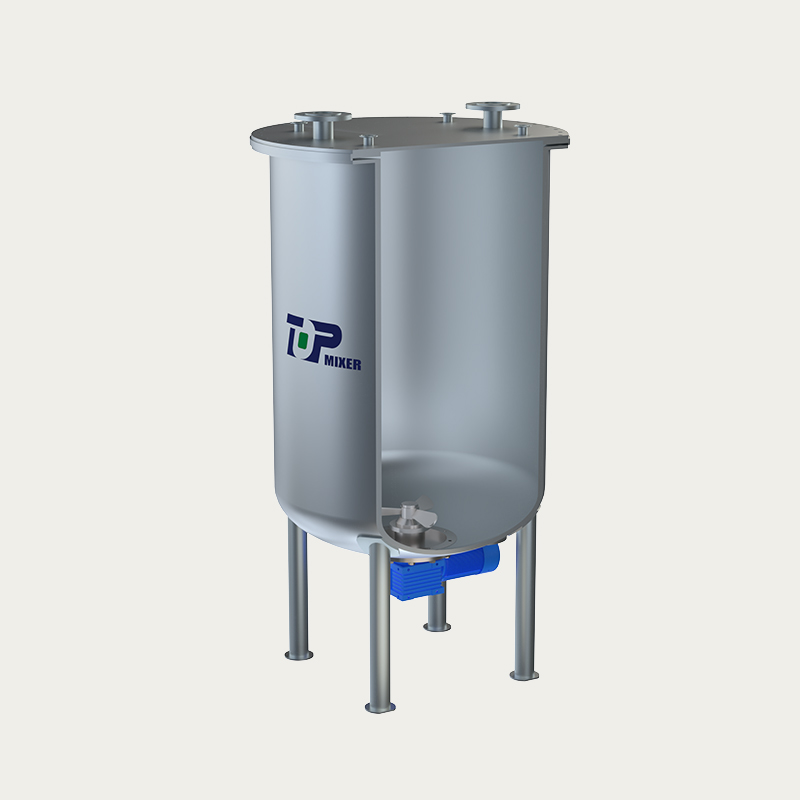
A bottom entry mixer, sometimes called a bottom entry agitator or bottom mounted mixer, is installed through the floor of a tank rather than through the top cover or the side wall. The motor and mechanical seal assembly are positioned below or directly at the tank floor, connecting to a comparatively short shaft that extends into the vessel where the impeller rotates near the base. Because the shaft length is shorter than in a typical top entry arrangement, the bottom entry mixer configuration tends to reduce bending load and vibration on the shaft and bearings during continuous operation.
Because the impeller draws and circulates material directly upward from the tank floor, some process engineers also refer to this equipment as a bottom feed mixer, since the mixing action effectively feeds and redistributes the batch from the bottom of the vessel toward the surface. In continuous or semi-continuous operations, a bottom mounted agitator configuration keeps the impeller close to the vessel floor, which supports consistent blending near the base of the tank where sedimentation is most likely to occur.
Typical Bottom Entry Mixer Components
- Direct-drive or gear-reduced motor mounted below the tank floor
- Mechanical seal housing at the point where the shaft penetrates the tank
- Short drive shaft connecting the motor to the impeller
- Low-shear impeller designed for gentle blending or light solids suspension
- Mounting flange securing the assembly to the tank floor
This compact arrangement is a common reason a bottom-entry mixer is selected for facilities where floor space around the tank is limited and a tall top-mounted drive assembly would be impractical.
What Is a Side Entry Mixer
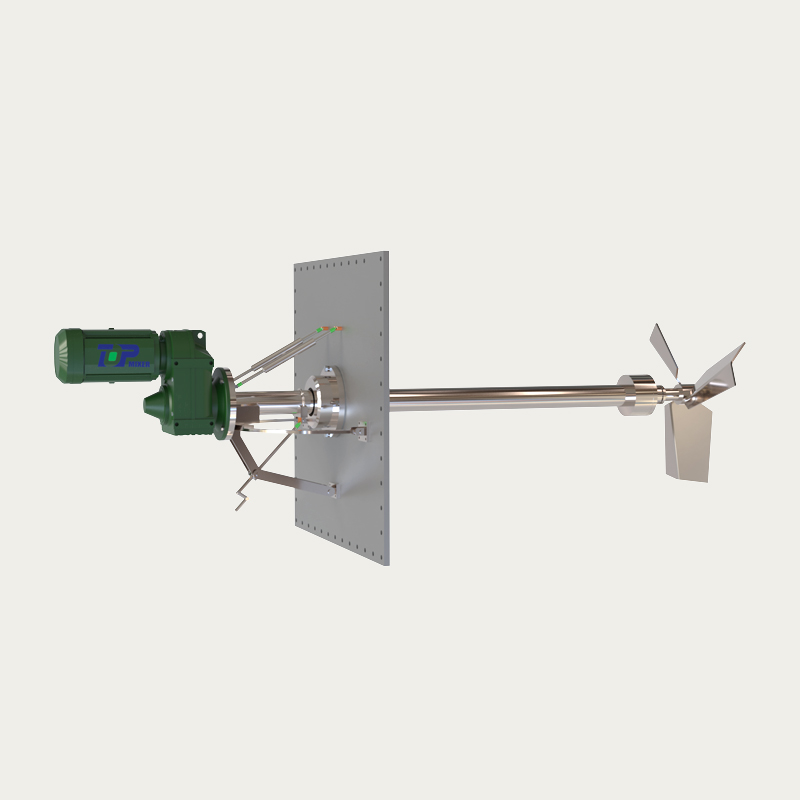
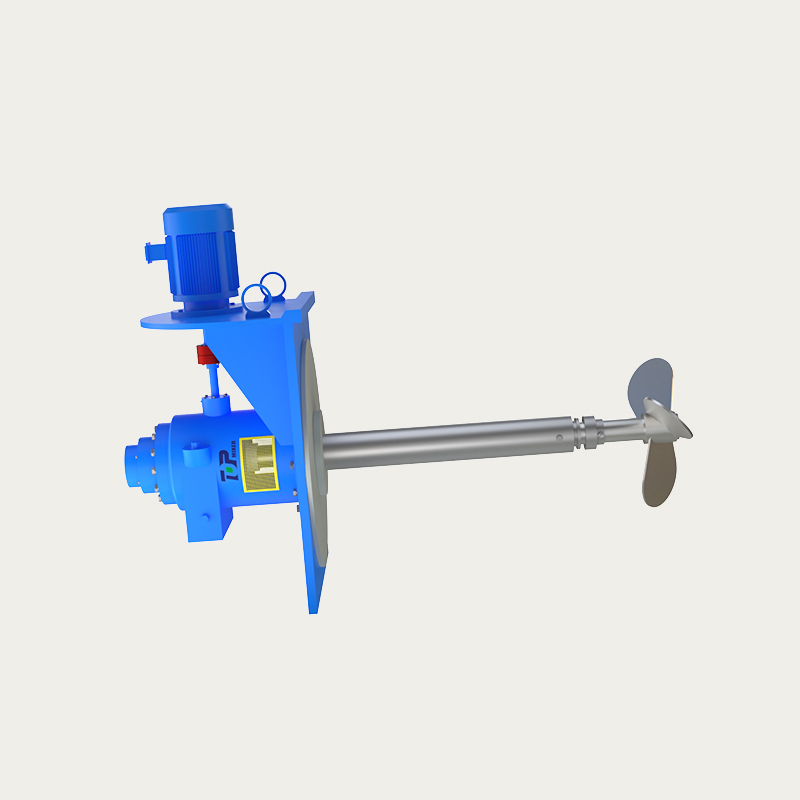
A side entry mixer is mounted through the side wall of a tank, usually positioned near the bottom third of the vessel and angled slightly downward so the impeller directs flow across the tank floor and up along the opposite wall. This configuration avoids the need to penetrate the tank roof or floor, which is one reason side entry mixers are widely used on large storage and blending tanks where the top cover may already be occupied by other fittings, gauges, or access hatches.
Because the drive unit sits outside the tank on the side wall, maintenance access for the motor and seal is usually possible without fully draining the vessel, which is a practical benefit for very large tanks where draining is time consuming. Side entry mixers are commonly associated with bulk storage applications such as large chemical tanks, wastewater basins, and other high-volume vessels rather than small batch or sanitary processing tanks.
Typical Side Entry Mixer Applications
- Large diameter storage tanks requiring bulk blending
- Tanks where the roof is not easily accessible for a top entry drive
- Applications where preventing sedimentation over a large tank floor area is the main goal
- Vessels where external maintenance access to the drive unit is preferred
Bottom Entry Mixer vs Side Entry Mixer: Feature Comparison Table
The table below summarizes typical characteristics of each configuration. Actual specifications vary by tank design, batch requirements, and the manufacturer supplying the equipment.
| Feature | Bottom Entry Mixer | Side Entry Mixer |
|---|---|---|
| Mounting Location | Through the tank floor | Through the side wall, angled near the bottom |
| Typical Shaft Length | Short | Short to medium |
| Typical Shear Level | Low | Low to medium |
| Common Tank Size | Small to mid-size vessels | Large to very large storage tanks |
| Cleaning Access | Often straightforward, supports closed systems | Accessible from outside the tank wall |
| Typical Industries | Dairy, cosmetics, biotechnology, select chemical tanks | Bulk storage, large chemical and water treatment tanks |
| Typical Viscosity Range | Low to medium viscosity | Low to medium viscosity, large volume |
Performance Characteristics Compared
Beyond the physical mounting location, the two configurations tend to differ in how they perform against several practical process considerations. The chart below presents a relative, illustrative comparison across four commonly discussed factors: shear control, cleaning ease, suitability for large tanks, and overall footprint efficiency.
Bottom entry mixers tend to score well on shear control and cleaning ease, which is one reason they are favored for delicate, sanitary, or shear-sensitive formulations. Side entry mixers tend to score better on large tank suitability, since their side-wall mounting supports bulk blending across large tank diameters without requiring a tall top-mounted assembly.
Bottom-Entry Mixer Structure Explained
The illustration below outlines the general structural layout of a typical bottom entry mixer installation, showing how the motor, seal, shaft, and impeller relate to the tank floor.
Reading the Bottom Entry Mixer Layout
In this layout, the motor sits below the tank, connected by a short drive shaft that passes through a mechanical seal at the tank floor. The mounting flange secures the entire assembly to the vessel, and the impeller rotates just inside the tank near the base, circulating the process liquid upward through the batch. This close-coupled structure is a defining feature of a bottom-entry mixer and is part of why the equipment tends to require less vertical headroom than top entry alternatives.
Where Bottom Entry Mixers and Side Entry Mixers Are Used
Bottom entry mixers appear frequently in industries that value hygienic design, gentle mixing action, and a compact footprint. Side entry mixers, on the other hand, are more closely associated with large-volume bulk storage and blending needs. The column chart below illustrates a general, non-exact usage pattern across common sectors.
The bottom entry mixer for chemical tanks is a practical option in blending, neutralization, and reaction vessels where gentle mixing is preferred and floor-mounted access simplifies routine maintenance. Similarly, a bottom entry mixer for storage tanks is often selected when floor space is limited and top access to the vessel is restricted by piping, platforms, or other fixed equipment. Meanwhile, side entry configurations remain common in very large water treatment and bulk chemical storage tanks where the priority is keeping a large volume of liquid uniformly blended.
Viscosity, Solids Suspension, and Batch Size Considerations
Tank size and product viscosity are two of the most practical factors when comparing a bottom entry mixer with a side entry mixer. The line chart below shows a general trend in how suitability tends to shift as tank size increases, based on typical process engineering patterns.
In general, a bottom entry mixer tends to remain a strong fit as tank size moves from small to medium, while a side entry mixer becomes increasingly practical as tank diameter grows very large, mainly because the side-wall mounting avoids the need for a tall drive assembly and simplifies external maintenance access on oversized vessels.
Multi-Factor Comparison
The radar chart below brings several factors together at once, comparing shear control, cleaning ease, large-volume suitability, installation access, sanitary process fit, and footprint efficiency for both configurations.
Taken together, these comparisons suggest that a bottom-entry mixer tends to lead in shear control, cleaning ease, and sanitary process fit, while a side entry mixer tends to lead in large-volume suitability. Neither configuration is universally better across every factor, which is why matching the mixer type to the specific tank and process is the practical approach.
Cleaning and Maintenance Differences
Routine maintenance planning often depends heavily on where the mixer drive and seal are located relative to the tank and the surrounding floor space.
- A bottom entry mixer places the seal at the tank floor, which can support closed-system operation and reduces the chance of product exposure during routine cleaning cycles.
- A side entry mixer places the seal on the tank side wall, allowing technicians to service the drive and seal from outside the tank without needing to access the area beneath the vessel.
- Bottom entry mixer installations often benefit from a small maintenance pit or accessible floor space beneath the tank for servicing the motor and seal housing.
- Side entry mixer installations typically require clear space along the tank side wall rather than beneath the vessel, which can simplify layout planning in some facilities.
Both configurations can be designed with mechanical seals that support relatively long service intervals, though the actual maintenance schedule depends on the product being processed, operating temperature, and how frequently the tank is cleaned between batches.
How to Choose Between a Bottom Entry Mixer and a Side Entry Mixer
The following steps outline a practical way to work through the decision for a specific tank and process.
- Confirm the tank size and shape, since large-diameter bulk storage tanks tend to favor a side entry mixer, while small to mid-size process vessels often favor a bottom entry mixer.
- Review the product viscosity and shear sensitivity, since low-shear formulations in dairy, cosmetics, or biotechnology applications commonly benefit from a bottom-entry mixer.
- Check available floor space beneath the tank versus space along the tank side wall, since this often determines which mounting style is physically practical.
- Consider cleaning frequency and hygienic requirements, since bottom entry mixers are frequently selected for closed, sanitary processing environments.
- Evaluate maintenance access needs, including whether the tank can be easily drained for service or whether external side-wall access is preferred.
- Discuss impeller type and mounting details with a qualified mixing equipment supplier who can review the specific batch, tank drawing, and process goals.
About Wuxi Top Mixer Equipment: A Bottom Entry Mixer Manufacturer
Wuxi Top Mixer Equipment Co., Ltd. was established in 2003, with its production base located in the Yangtze River Delta economic zone in Wuxi. As a bottom entry mixer manufacturer, the company focuses on fluid, powder, and slurry mixing equipment, covering research, design, and production for a range of process industries. The organization is structured around dedicated divisions, including a powder and slurry mixing division, a biomass energy and environmental protection division, a food and pharmaceutical division, and a fine chemical mixing division, which allows engineering teams to focus on the specific requirements of each application area.
The company designs and builds bottom-entry mixer systems alongside other mixing configurations for tanks used in food processing, chemical blending, and related industrial settings. Products are supplied to customers across mainland China as well as international markets including regions in North America, Europe, and Southeast Asia, supported by an experienced engineering team that works directly with customers on tank drawings, process conditions, and mixer selection.
Frequently Asked Questions
|
Q1: What is a bottom entry mixer A bottom entry mixer is an industrial mixing device installed through the floor of a tank, with the impeller shaft entering from below rather than through the top or side wall. This design supports direct-drive operation and gentle, low-shear blending in process vessels. |
Q2: What is a bottom entry agitator A bottom entry agitator refers to the same category of equipment as a bottom entry mixer, with the agitator shaft and impeller mounted at the tank base. The term agitator is commonly used interchangeably with mixer in process engineering. |
|
Q3: How does a bottom entry mixer work The motor and seal assembly sit below or at the tank floor, connecting to a short shaft that extends into the vessel where the impeller rotates. This close-coupled arrangement can reduce vibration compared with longer top entry shafts. |
Q4: What is a bottom mounted mixer used for A bottom mounted mixer is typically used for blending, homogenizing, and helping prevent settling of solids in low to medium viscosity liquids, commonly in dairy, cosmetics, and biotechnology applications. |
|
Q5: What are the advantages of a bottom entry mixer Common advantages include a compact footprint, straightforward cleaning access, low-shear mixing for delicate formulations, and compatibility with closed tank systems and reduced headroom needs. |
Q6: Where are bottom entry mixers used They are used across dairy processing, food and beverage production, cosmetics manufacturing, biotechnology, and select chemical processing tanks that need floor-mounted access. |
|
Q7: Bottom entry mixer versus top entry mixer A top entry mixer enters from above with a longer shaft and roof-mounted support, while a bottom entry mixer enters from the floor with a shorter shaft and reduced headroom requirements. |
Q8: Bottom entry versus side entry mixers A bottom entry mixer penetrates the tank floor and suits smaller, gentle mixing needs, while a side entry mixer penetrates the side wall near the bottom and suits large bulk storage tanks. |
|
Q9: Is a bottom entry mixer suitable for high viscosity liquids Bottom entry mixers are generally better suited to low and medium viscosity liquids. Higher viscosity products often call for additional impeller and power review alongside this configuration. |
Q10: Can a bottom entry mixer suspend solids Yes, a bottom entry mixer can help keep light to moderate density solids suspended, particularly in tanks with rounded or sloped bottoms that support even flow from the impeller near the floor. |


- No. 118, Chuangye Road, Jieshou Town, Gaoyou City, Yangzhou, Jiangsu Province, China
- [email protected]
- Landline: +86-0510-83383966 +86-0510-83390667
- Telphone: +86-0510-83390667
- Mr. Chen: +86-18061519769 Mr. Xu: +86-13706183972
- Mr. Lu: +86-18915337056
- Product Link
- Top-Entry Mixer
- Bottom-Entry Mixer
- Side-Entry Mixer
- SIGN UP
- Sign up to be the first to find out the latest news from Top Intelligent Technology
- Subscribe

