

 English
 日本語
日本語 русский


Dispersion Blade Selection Guide: Tip Speed, Geometry, and Wear Life for Industrial Mixing
Content
- 1 What a Dispersion Blade Does, and What It Cannot Do
- 2 Dispersion Blade Geometry: Which Profile Does Which Job
- 3 Tip Speed and Disc Diameter: The Two Numbers That Decide Fineness
- 4 Matching the Blade to Viscosity and Solids Loading
- 5 Material, Hardness, and Wear Life
- 6 Installation Geometry: Offset, Baffles, and Disc Height
- 7 Symptom Check: When Fineness of Grind Stalls
- 8 A Short Specification Checklist
- 9 Dispersion Blade FAQ
- 9.1 What tip speed should a dispersion blade run at?
- 9.2 What is the difference between a dispersion blade and a mixing propeller?
- 9.3 Which material is best for abrasive pigments?
- 9.4 How do I know when a dispersion blade is worn out?
- 9.5 Can one disc handle both wetting and fine dispersion?
- 9.6 Why does a dispersion batch get hot and foam?
A pigment paste that stalls at a Hegman reading of 5, or a cathode slurry that still shows agglomerates after ninety minutes, is usually blamed on the mill. In many of the cases we are asked to review, the cause sits at the end of the shaft: the dispersion blade.
The short answer is that a dispersion blade does one job well. It wets powder into liquid and breaks agglomerates apart at the tooth tips. It does not reduce primary particles, it does not stabilise a suspension, and it cannot compensate for a shaft mounted in the centre of an unbaffled tank. When tip speed, disc diameter, tooth geometry, blade position, and material all match the formulation, most pastes and slurries reach target fineness in 20 to 40 minutes. When one of those five is wrong, batch times commonly double, and the extra time heats the product instead of dispersing it.
The figures below are typical industrial ranges taken from standard mixing engineering practice. Treat them as a starting point for a trial on your own formulation.
 |
 |
What a Dispersion Blade Does, and What It Cannot Do
Every dispersion is three steps. Wetting replaces the air layer on a particle with liquid. Deagglomeration separates clusters held together by van der Waals forces. Stabilisation stops those particles from re-forming clusters, and that is a formulation decision rather than a hardware one.
The blade acts only on the middle step, and only in a thin zone. Shear rate peaks within a few millimetres of the tooth tip and falls away quickly, which is why a 250 mm disc running at 20 m/s inside a 10,000 litre tank still needs half an hour. The shear zone has to pass through the entire batch, and batch time is set by turnover rather than by rpm alone.
Two conclusions follow. A dispersion blade is the wrong tool for genuine milling: if primary particles are 0.2 micron and the agglomerates in the tank are 20 micron, a toothed disc will bring the batch down to roughly primary size and stop there. And anything that prevents the batch being pumped past the disc — a centred shaft, missing baffles, too little free liquid, solids settled on the base — turns a good blade into an expensive paddle.

Dispersion Blade Geometry: Which Profile Does Which Job
For the same motor power, geometry decides whether you get shear or flow.
- Saw-tooth disc: a flat disc with 8 to 24 teeth around the rim. Almost all input energy becomes local shear and very little becomes pumping, which is exactly what wetting and agglomerate breakdown need.
- Slotted or perforated disc: the same outer profile with holes through the face. Material flows through the disc rather than around it, the low-shear pocket at the centre shrinks, and 2,000 to 5,000 cP pastes behave better than with a solid plate.
- Rotor-stator head: a toothed rotor inside a slotted stator with a few millimetres of gap. It produces the most intense shear, but in a very small volume, so throughput per kilowatt is lower and high solids loadings are impractical.
- Propellers and turbines: flow generators at 3 to 8 m/s. They blend and suspend solids, but they do not break pigment agglomerates at practical speeds.
The chart below compares the profiles qualitatively. The scores are orientation indices, not measured values.
Profile comparison: saw-tooth disc vs pitched-blade turbine
Saw-tooth dispersion disc Pitched-blade turbine
Tip Speed and Disc Diameter: The Two Numbers That Decide Fineness
Tip speed equals pi times disc diameter times rotational speed. A 250 mm disc turning at 1,500 rpm runs at 19.6 m/s, comfortably inside the dispersing window. A 150 mm disc needs about 2,400 rpm to reach the same figure, which is why undersized discs in large tanks rarely deliver.
Common mixing references place saw-tooth dispersion work between 18 and 25 m/s. Below about 15 m/s, agglomerates survive the pass. Above 25 m/s, the extra energy mostly becomes heat, air entrainment, and faster tooth wear rather than a finer grind.
Typical peripheral speed windows by agitator type (m/s)
Ranges reflect common mixing engineering practice; confirm by trial.
Scale-up follows the same numbers. Keep tip speed constant when the duty is dispersion, and keep power per unit volume constant when the duty is blending or solids suspension. Confusing the two is a common reason a pilot batch cannot be reproduced at production scale.
 TOPA005 FS1 Series High Speed DisperserBased on Top's years of experience and unique technology and the application of advanced measurement and analysis technology, we designed high-efficiency impellers wit...View Product →
Matching the Blade to Viscosity and Solids Loading
Viscosity at process temperature, plus solids loading, chooses the hardware. The table below gives practical starting points for the first trial.
| Product viscosity | Blade type | Tip speed | D/T ratio | Typical duty |
|---|---|---|---|---|
| Up to 1,000 cP | Saw-tooth disc | 18-25 m/s | 0.30-0.40 | Pigment wetting, solvent coatings, inks |
| 1,000-5,000 cP | Slotted or perforated disc | 15-20 m/s | 0.35-0.50 | Battery slurry, colour pastes, agrochemicals |
| 5,000-20,000 cP | Rotor-stator head with anchor | 12-18 m/s | 0.40-0.60 | Adhesives, sealants, thick pastes |
| Above 20,000 cP | Planetary or ribbon, not a disc | 1-5 m/s | 0.60-0.90 | High-solids pastes, kneading |
Battery slurry sits in the middle band: high solids, abrasive active material, and a slotted disc that usually outperforms a solid plate because material keeps moving through the disc face instead of only around the rim. Production examples are collected in our lithium battery industry project notes.
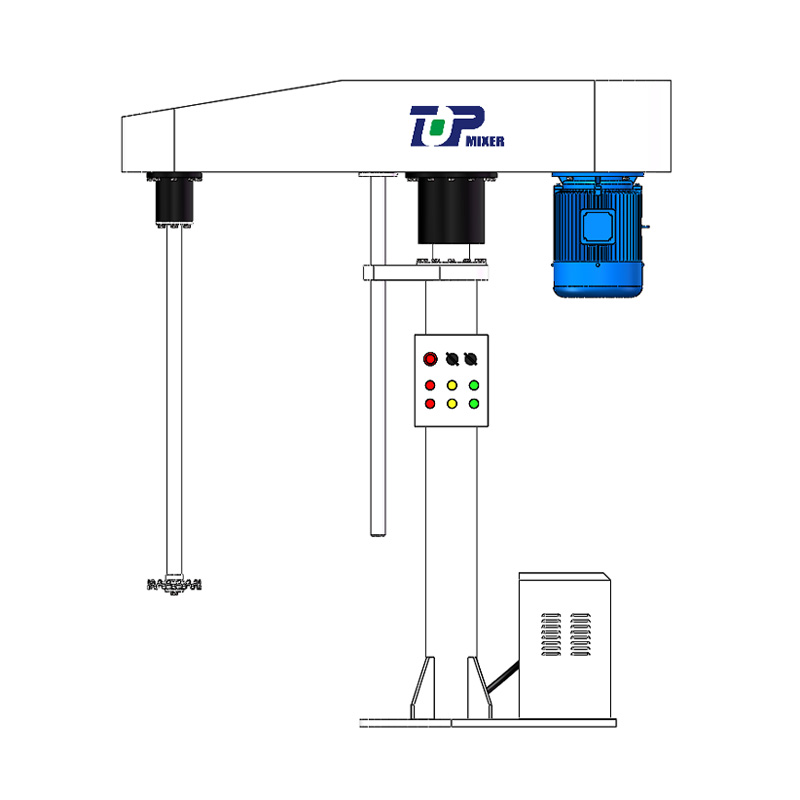 TOPH51 Series FL High Speed DisperserThis series of dispersion mixers can be equipped with a toothed dispersion tray for high-speed dispersion stirring, or various types of stirring machines for stirring ...View Product →
Material, Hardness, and Wear Life
Most industrial dispersion discs are made from 304 or 316L stainless steel. That suits organic pigments and hygienic duty. It does not suit rutile titanium dioxide, iron oxide, ceramic fillers, or cathode active material, where an abrasive slurry can round the tooth edges within a few hundred operating hours.
For abrasive duty the options are hardened martensitic or duplex stainless, a hardened and ground tooth profile, or a polymer coating where metal contamination must be avoided. Two early warnings of wear are a fineness of grind that drifts upward and a batch time that creeps. Measure the tooth edge radius during scheduled shutdowns: once it reaches roughly 0.5 to 1 mm, the local shear that performs the deagglomeration is largely gone.
Balance matters at these speeds as well. A disc running at 20 m/s on an overhung shaft turns imbalance and runout into vibration, and then into seal or bearing failure. Suppliers who model the impeller and tank before quoting, using CFD flow analysis for example, can show where the high-shear zone actually falls, which helps more at specification stage than a nominal motor rating does.
 |
 |
 |
 |
Installation Geometry: Offset, Baffles, and Disc Height
Hardware is half the answer. Position is the other half.
- Shaft offset: mount the shaft 1/6 to 1/4 of the tank diameter off centre. A centred shaft in an unbaffled tank lets the whole batch rotate with the disc, and the relative velocity that produces shear collapses.
- Baffles: one to four vertical plates, each about one tenth of the tank diameter wide, convert rotation into top-to-bottom turnover.
- Disc height: 0.5 to 1 disc diameter above the tank bottom. Lower buries the disc in settled solids; higher leaves a dead layer on the base.
- Submergence: at least 1.5 disc diameters below the liquid surface to limit vortexing and air entrainment.
- Shaft support: long shafts at dispersing speeds need a steady bearing or a shorter overhang, so check the critical speed before ordering hardware.
Isometric view: dispersion disc assembly in the tank
Symptom Check: When Fineness of Grind Stalls
- Grind stalls at 5 to 6 Hegman with normal viscosity: tip speed is too low, or the disc is undersized for the batch volume.
- Powder floats and forms lumps: the vortex is too weak, or powder is fed faster than it can be wet out.
- Fine near the wall, coarse at the centre: centred shaft or missing baffles, so the batch rotates instead of circulating.
- One side of the disc wears faster: shaft runout or coupling misalignment.
- Foaming and air entrainment: tip speed above 25 m/s, or the disc running too close to the liquid surface.
Where foaming comes from the formulation rather than the operating point, a defoaming paddle can be fitted on the same shaft above the dispersing disc.
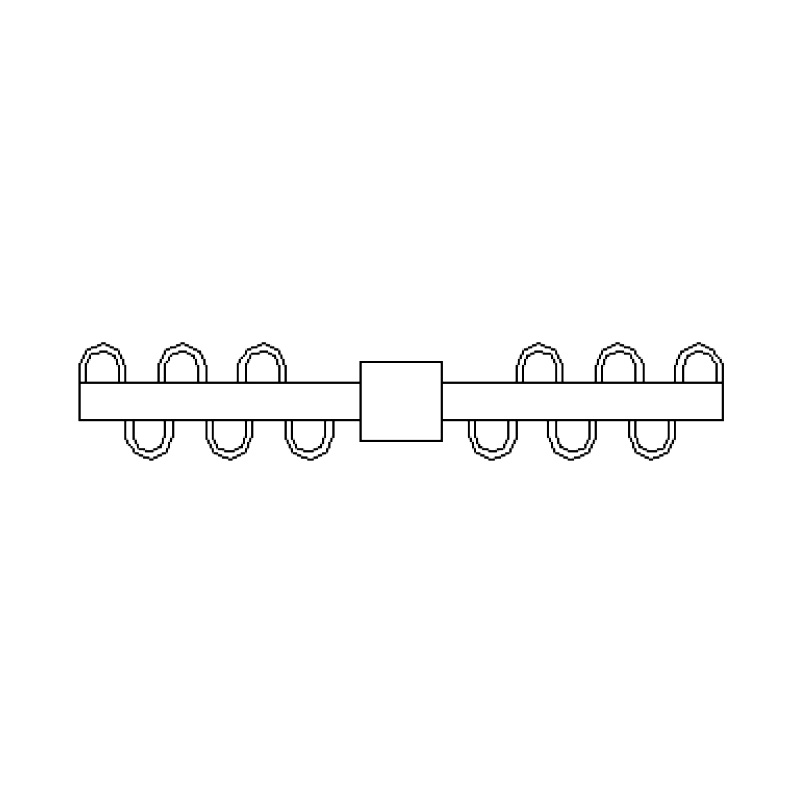 XPJ Defoaming Paddle Defoaming AgitatorXPJ defoaming paddle is a U-shaped grid strip of the blade, which mechanically destroys the medium foam generated during stirring, and inhibits the medium foam., suita...View Product →
A Short Specification Checklist
- State the target fineness of grind and the test method, not only the batch time.
- Give viscosity at process temperature, solids loading, and whether the solids are abrasive.
- Confirm tank diameter, working volume, and available shaft length before fixing disc diameter.
- Fix tip speed for dispersion duty and power per volume for blending duty, and do not mix the two.
- Specify tooth material, hardness, and coating options for abrasive or contamination-sensitive products.
- Ask for turnover time and shear-zone position, ideally backed by flow modelling, rather than a motor rating alone.
Dispersion Blade FAQ
What tip speed should a dispersion blade run at?
Most saw-tooth dispersion discs run between 18 and 25 m/s at the tooth tip. Below roughly 15 m/s agglomerates survive the pass; above 25 m/s the extra energy mostly turns into heat, air entrainment, and wear.
What is the difference between a dispersion blade and a mixing propeller?
A propeller moves volume, a dispersion blade creates local shear. Propellers at 3 to 8 m/s blend and suspend solids, while a toothed disc at 18 to 25 m/s breaks agglomerates apart. Blending a pigment paste with a propeller will not improve the Hegman reading.
Which material is best for abrasive pigments?
304 or 316L stainless is fine for organic pigments. For rutile titanium dioxide, iron oxide, ceramic fillers, or cathode active material, choose hardened martensitic or duplex stainless, or a coated disc where metal contamination is critical.
How do I know when a dispersion blade is worn out?
Watch for fineness of grind drifting upward and batch times creeping up. Measure the tooth edge radius at shutdown; once it reaches about 0.5 to 1 mm, the shear is gone and the disc should be re-sharpened or replaced.
Can one disc handle both wetting and fine dispersion?
It can handle both stages in one vessel if powder is added under a strong vortex and tip speed is held near the top of the range. It cannot replace a bead mill, because a disc will not reduce primary particles below their agglomerate size.
Why does a dispersion batch get hot and foam?
Usually a tip speed above 25 m/s, a disc too close to the liquid surface, or too little free liquid. Lower the disc, reduce the speed, or split the addition into two stages.
Most dispersion problems turn out to be geometry problems. Check tip speed, disc diameter, tooth condition, and blade position before adding time or horsepower to the batch. If the numbers need a second opinion, our engineers review tank geometry, product viscosity, and fineness targets against the disperser range and come back with a concrete setting to trial.



- No. 118, Chuangye Road, Jieshou Town, Gaoyou City, Yangzhou, Jiangsu Province, China
- [email protected]
- Landline: +86-0510-83383966 +86-0510-83390667
- Telphone: +86-0510-83390667
- Mr. Chen: +86-18061519769 Mr. Xu: +86-13706183972
- Mr. Lu: +86-18915337056
- Product Link
- Top-Entry Mixer
- Bottom-Entry Mixer
- Side-Entry Mixer
- SIGN UP
- Sign up to be the first to find out the latest news from Top Intelligent Technology
- Subscribe

