

 English
 日本語
日本語 русский


High Speed Mixer Selection: Tip Speed, Blade Geometry, and Tank Layout
Content
- 1 How a High Speed Mixer Creates Shear
- 2 Tip Speed: The First Number That Matters
- 3
- 4 Blade Geometry and Viscosity Boundaries
- 5 Shaft Support, Seals and the Parts That Fail First
- 6 Industries That Rely on High Speed Mixers
- 7 High Speed Mixer FAQ
- 7.1 Q1: What is the difference between a high speed mixer and a high shear mixer?
- 7.2 Q2: What mixing speed do I need to disperse powders?
- 7.3 Q3: Can a high speed disperser handle high viscosity materials?
- 7.4 Q4: What causes a high speed mixer shaft to vibrate or a bushing to wear?
- 7.5 Q5: What is the working principle of a top-entry high speed mixer?
- 7.6 Q6: How do I choose between a disperser and an emulsifier?
Ask a maintenance team why their dispersion tank keeps producing gritty batches, and the answer usually comes down to the same equipment decision: they are using a slow-speed agitator on a job that needs a high speed mixer. A high speed mixer — the machine industrial buyers call a high-speed disperser when it is fitted with a toothed disc — solves wetting, de-agglomeration and homogenizing problems that ordinary propellers and turbines simply cannot handle because they do not generate enough shear.
Before comparing motor power or price, compare four engineering parameters: tip speed, blade geometry, product viscosity, and the mechanical layout of the shaft, seal and tank. These four decide whether your next mixer runs for years or fails in the first season.
How a High Speed Mixer Creates Shear
A high speed mixer works by spinning a small-diameter blade very fast instead of moving a large blade slowly. The toothed disperser disc is typically one-third to one-half of the tank diameter, and at rotational speeds of 1000–3000 rpm it drives a saw-blade edge through the liquid at 15–30 m/s. That edge velocity generates intense local shear, which rapidly collapses agglomerates and forces liquid into layers that peel off the pigment or powder surface.
At the same time, the disc draws material downward through the center and throws it outward against the tank wall, creating a torus-shaped circulation pattern. A batch that a paddle agitator can only move, a disperser can actually work.
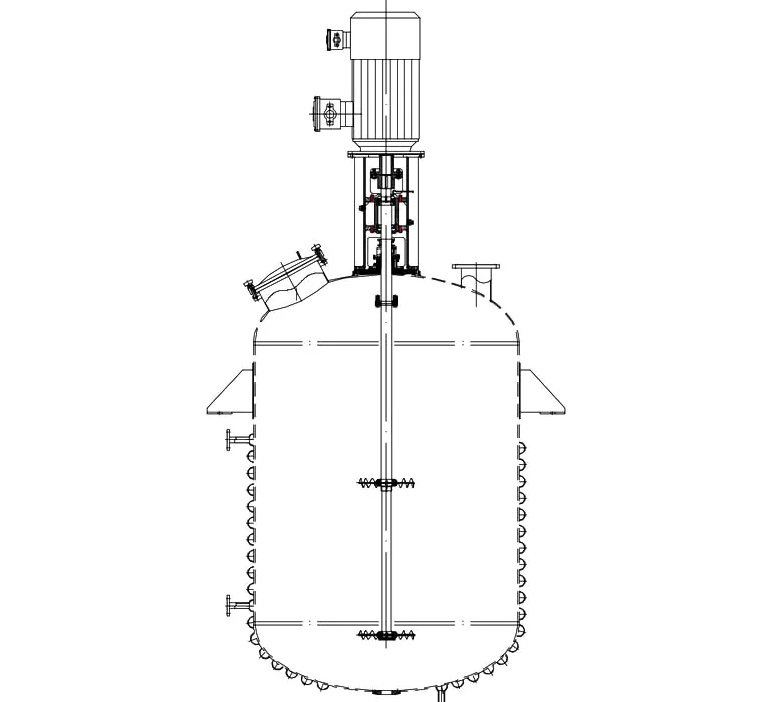
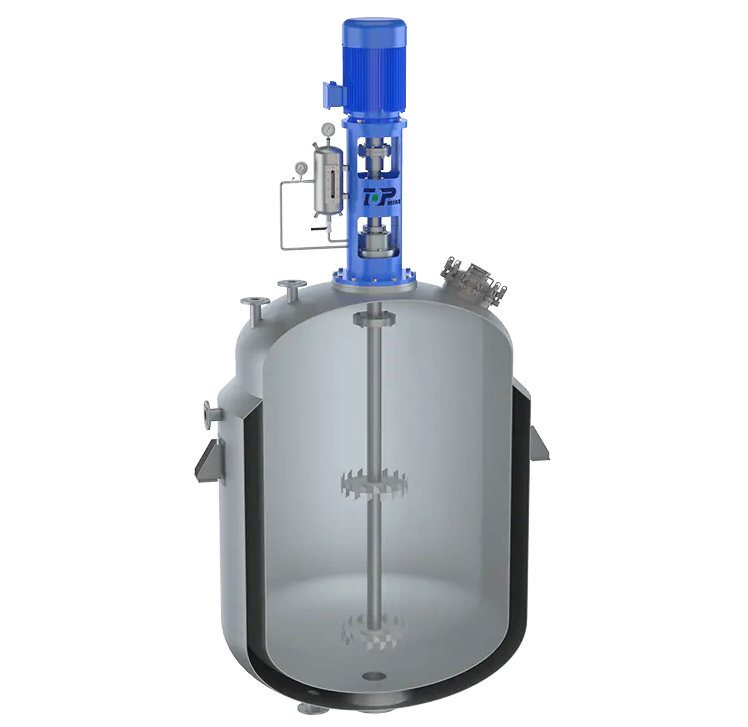
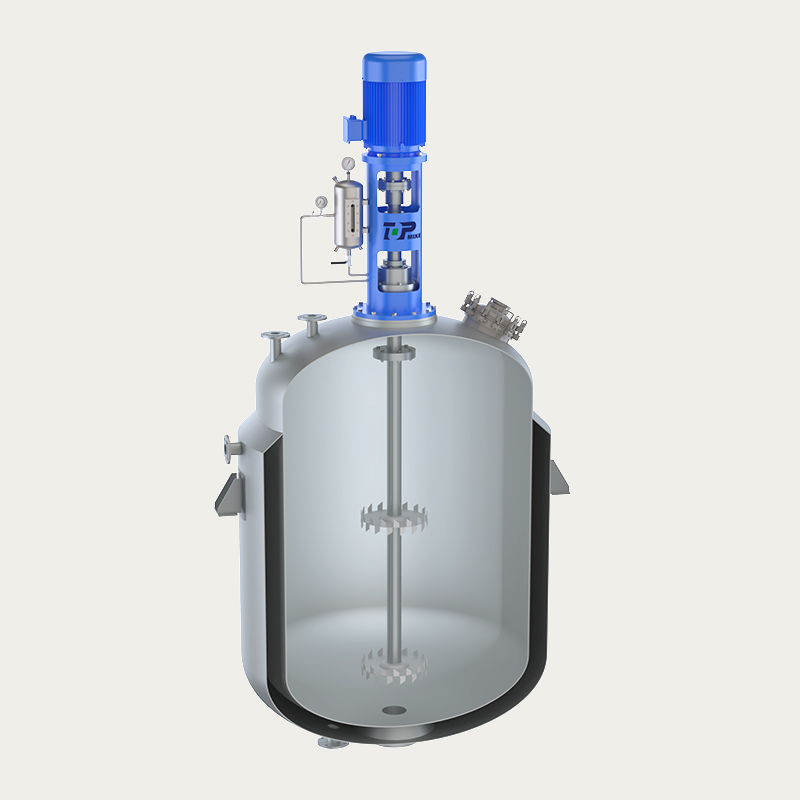
Typical top-entry layout: the toothed disc is located near the tank bottom, and a bushing supports the lower end of the long shaft.
| Component | Function | Selection check |
|---|---|---|
| Drive (motor, gearbox or belt) | Determines torque and speed range of the shaft | Tip speed target, duty cycle, start-up torque |
| Shaft | Transfers torque from drive to blade | Length, critical speed, run-out tolerance |
| Mechanical seal | Prevents process leakage at the vessel nozzle | Vapor pressure, solids content, temperature |
| Bushing / steady bearing | Supports the lower end of a long shaft | Slurry abrasiveness, product lubricity |
| Disperser blade | Generates shear and circulation | Tooth pattern, blade diameter, tip speed |
Tip Speed: The First Number That Matters
Tip speed is the circumferential velocity of the blade edge: π × blade diameter × rotational speed. It is the parameter that correlates best with the shear energy delivered into the product, and it is the first number a mixing engineer calculates. Motor power is chosen after the blade diameter and tip speed are fixed, not before.
Typical ranges from common industrial mixing practice are shown below.
For pigment and filler dispersion, the practical working window is usually between 18 and 25 m/s. Below about 12 m/s a toothed disc stops breaking agglomerates reliably.
If the tip speed window is wrong, no amount of motor power will fix the batch. Below 18 m/s, dispersion cycles stretch out and fineness targets are missed; above 30 m/s the mixer mainly heats the product and accelerates seal wear.
Because small changes in blade diameter create large changes in tip speed, the reliable way to match a machine to a process is to work from vessel geometry and the required physical result, then let tools like CFD flow analysis verify the flow pattern before cutting a single part. That is the difference between a generic quote and a working solution.
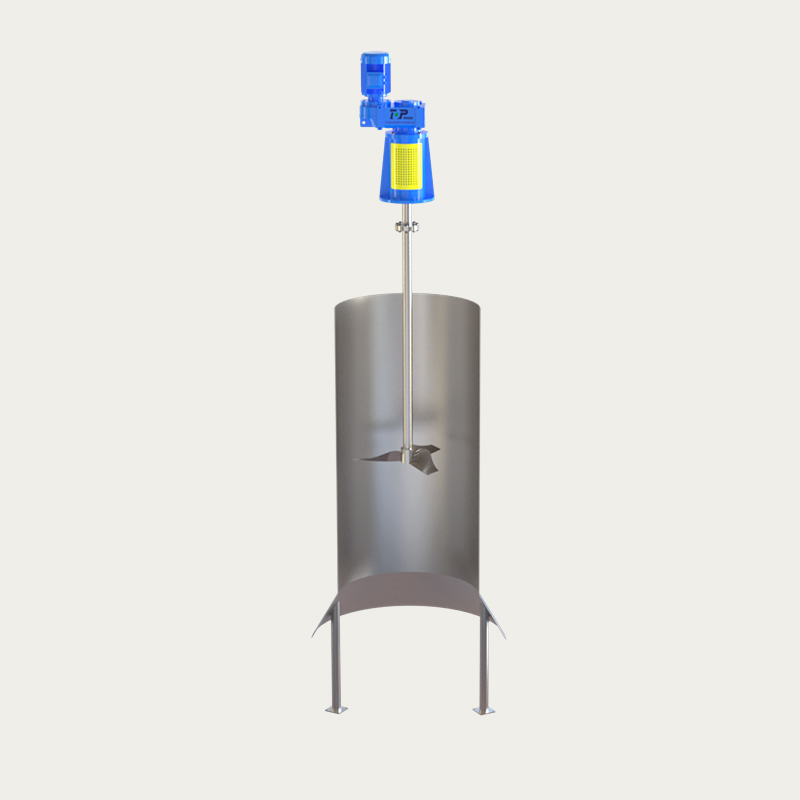
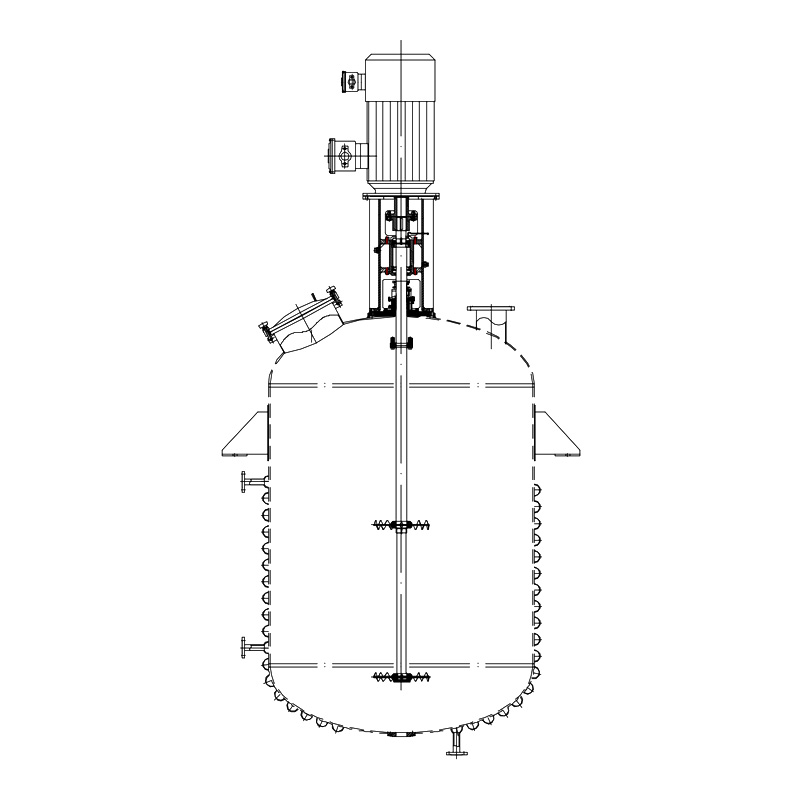 FS1 High Speed Disperser with Tailored Impeller for Process MatchingThis disperser features high-efficiency impellers and a compact drive, enabling precise tip-speed and flow control. Its design suits vessel-specific requirements, supported by CFD verification, making it a practical choice for reliable scale-up in demanding mixing applications.View Product →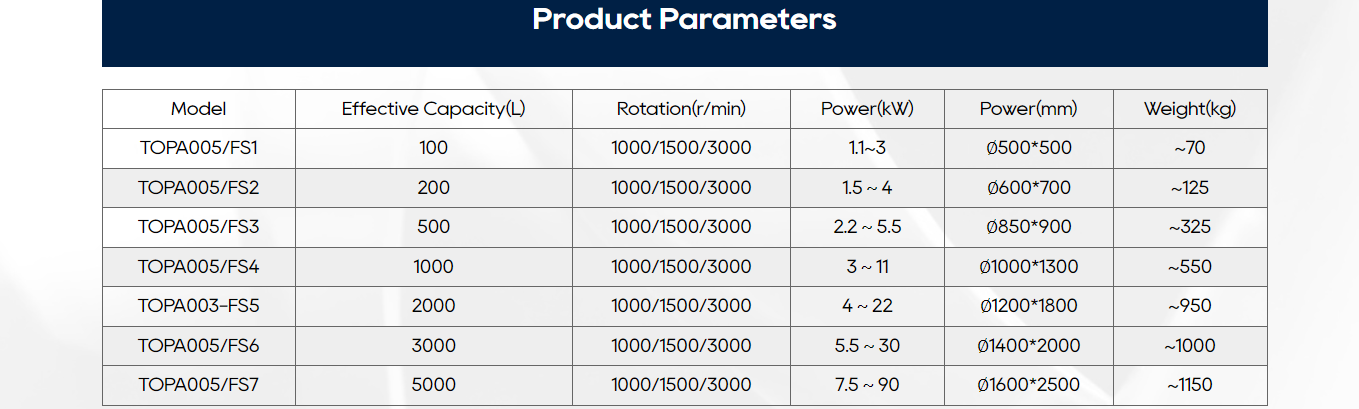
 |
 |
Blade Geometry and Viscosity Boundaries
Not every high speed mixer uses the same blade. The standard toothed disperser disc is the default choice for paints, inks and adhesive fillers. A fine-tooth "deflussure" disc produces higher local shear for carbon black and battery slurries. A high-lift blade adds axial pumping for heavy pastes, while a serrated turbine is chosen when the mixer also has to turn the whole tank over.
Buyers frequently underestimate the coupling between blade selection and viscosity. The chart below shows the practical upper viscosity limit for common impeller families when running at useful dispersion speeds.
Values represent typical sizing practice for shear-thinning, thixotropic products, not a hard equipment limit.
Above these ranges, a high speed mixer is not eliminated, but it must be re-engineered: heavier shafting, larger or toothed discs, deeper tank baffles, or a two-stage approach where a planetary or high-torque mixer pre-blends the paste and a disperser finishes the dispersion.
Common high-speed blade types and when they are chosen| Blade type | Shear intensity | Pumping | Practical viscosity range | Typical use |
|---|---|---|---|---|
| Toothed disperser disc | High | Low–moderate | Up to ≈50 Pa·s | Paints, inks, pigment pastes |
| Fine-tooth deflussure disc | Very high | Low | Up to ≈30 Pa·s | Battery slurries, carbon black |
| High-lift disc | Moderate–high | Moderate–high | Up to ≈100 Pa·s | Adhesives, heavy fillers |
| Serrated turbine | Moderate | High | Up to ≈20 Pa·s | Emulsions, tank turnover |
Shaft Support, Seals and the Parts That Fail First
If there is one recurring field complaint, it is the lower-end bushing wearing out prematurely on a top-mounted high speed mixer. In a dairy tank, a paint tub or a solvent batch, the guide bushing sits in the product and is lubricated by it. When the slurry contains abrasive solids — titanium dioxide, carbon black, silica — the bushing wears, the shaft begins to orbit, and the mechanical seal soon follows.
Three ways to design this risk out:
- Choose a bushing material compatible with both the product and the abrasive load — ceramic or engineered polymers for slurries, a robust metallic bushing for clean liquids.
- Keep the shaft short and the blade close to the steady bearing. Long overhung shafts convert a small imbalance into a large deflection.
- Verify that the first and second lateral critical speeds sit safely above the operating speed range, especially on variable-speed machines.
On the sealing side, specify a double mechanical seal or a magnetic drive when the product is toxic, flammable, or cannot tolerate leakage. On large top-entry machines, a replaceable seal cartridge lets maintenance swap the seal without pulling the drive — a detail worth asking about before purchase.
For operators who standardize a single disperser across several changeable tanks, a dedicated high-speed dispersing machine with its own drive and adjustable height is often more economical than installing individual mixers on every vessel.
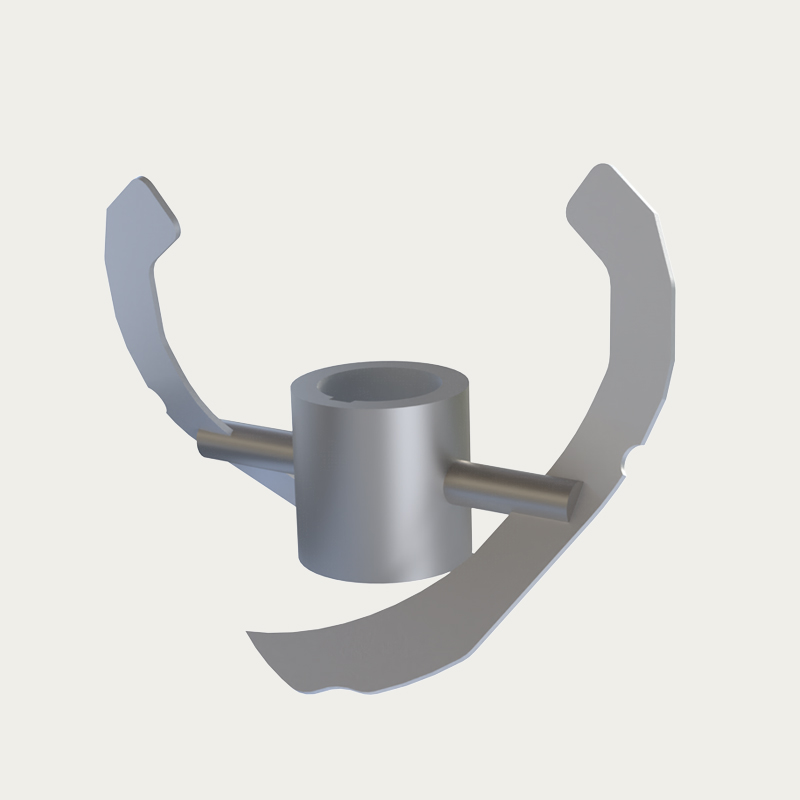
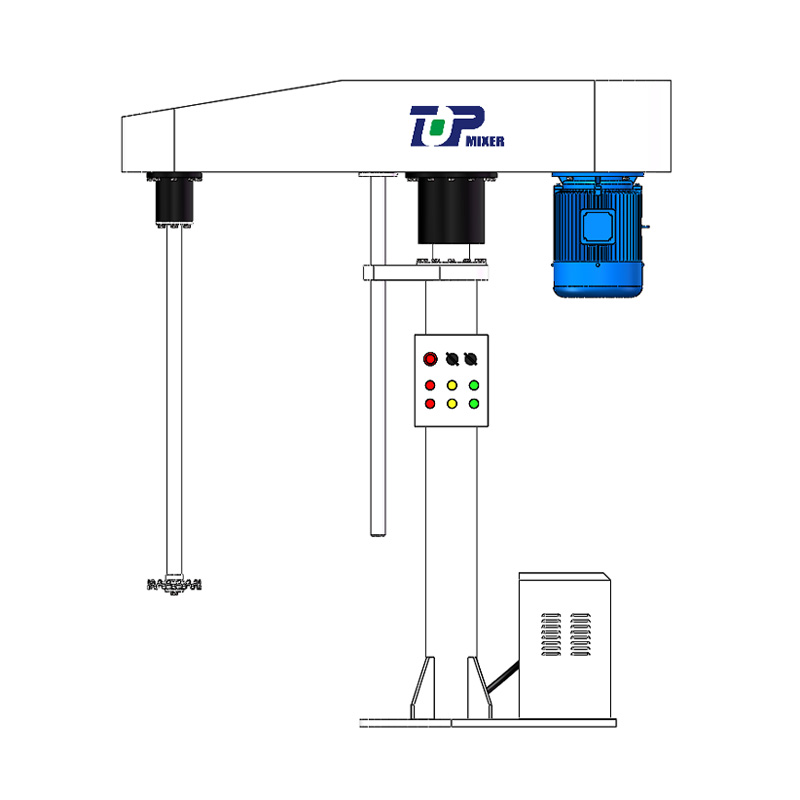 FL High Speed Disperser for Multi-Purpose Solid-Liquid MixingEquipped with a toothed dispersion disc, this mixer handles coatings, dyes, pigments, and adhesives with minimal air absorption. It offers fast dissolution and fine particle reduction, ideal for operators using a single unit across multiple tanks or applications.View Product →
Industries That Rely on High Speed Mixers
The most common duty is dispersing solids into liquids, but the technique extends far beyond pigment grinding:
- Paints and coatings — pigment and filler dispersion, binder pre-wetting.
- Inks and printing pastes — carbon black de-agglomeration, color development.
- Adhesives and sealants — fillers, rheology control, fast powder incorporation.
- Battery materials — conductive carbon, cathode and anode slurries.
- Chemical and pharmaceutical — suspensions, hot melts, ointments.
- Food and cosmetics — emulsions, creamy dressings, toothpaste.
Where the process needs fine droplets rather than just de-agglomerated particles, an emulsifying mixer is the logical next step after a disperser. A hydraulic emulsifying mixer allows smooth speed adjustment under load, which is important for shear-sensitive formulations.
A disperser maximizes shear; turbines balance pumping and shear; propellers are efficient movers but weak at breaking agglomerates.
Equipment suppliers with a broad record of installations can usually point to how the same machine behaves in different duties. For example, a food plant that needs both powder wetting and oil-water emulsification may install a disperser and a hydraulic emulsifier on the same line, or choose a machine that can switch between disc and rotor-stator heads.
Documented installations across chemical and related process industries show that tank geometry, not just blade type, must be reviewed before final selection. A tank with wide baffles and a flat bottom changes the flow pattern completely compared with a dished-bottom vessel.
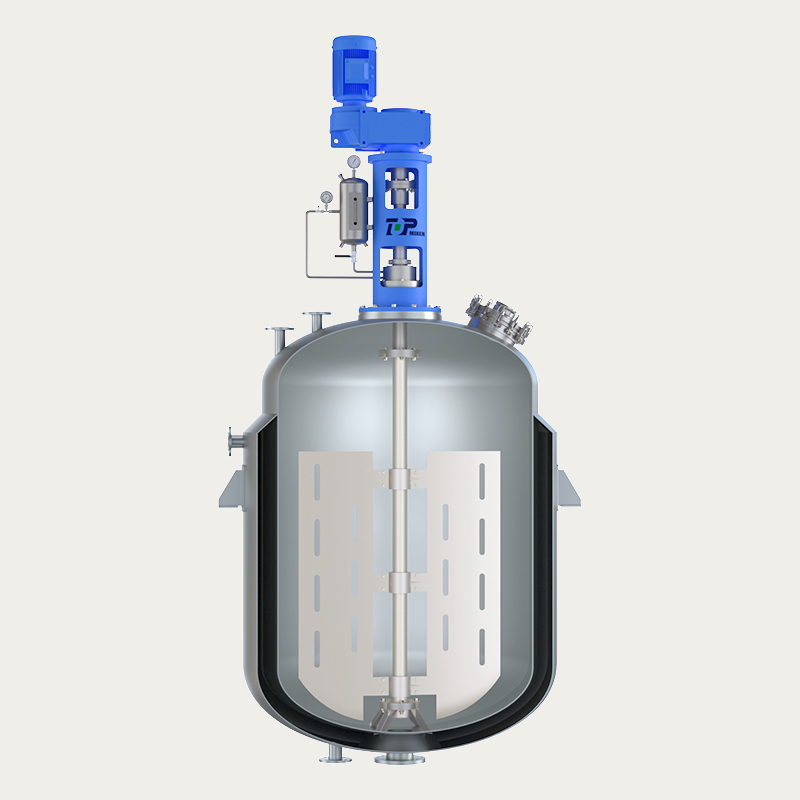
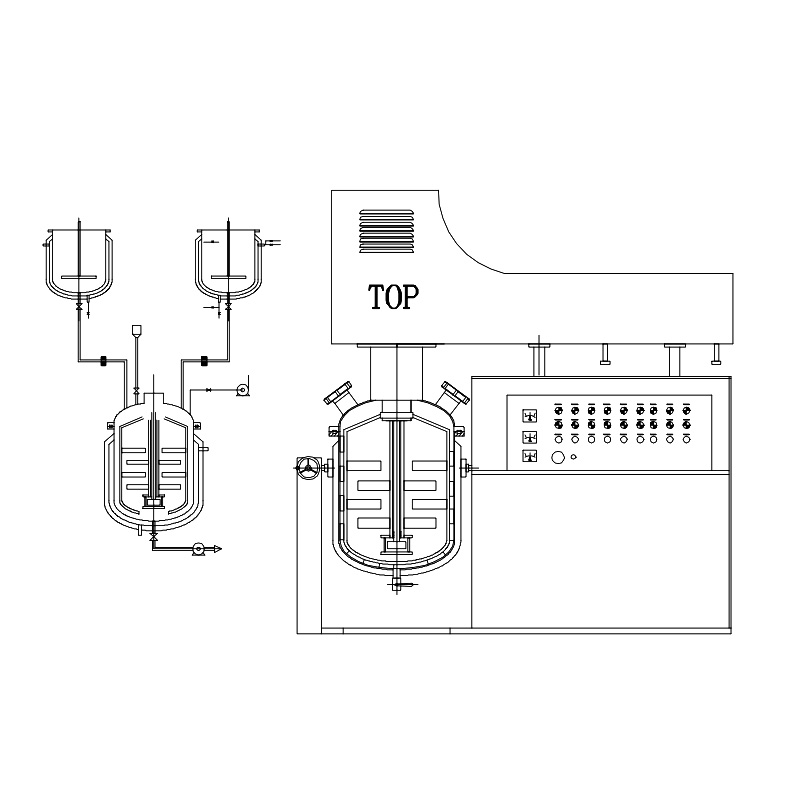 RH Emulsified Hydraulic Mixer for High-Viscosity Cosmetic PastesA patented emulsifier designed for foundation, cream, and toothpaste production. Its internal and external circulation homogenizer and vacuum system ensure excellent emulsification and defoaming, while hygienic stainless steel construction meets strict sanitation standards. Vendor expertise in such systems is worth evaluating.View Product →
Before you finalize a specification, inspect how the manufacturer has solved similar problems. Vendor experience with chemical industry mixing projects is a more honest predictor of performance than any datasheet table.
High Speed Mixer FAQ
Q1: What is the difference between a high speed mixer and a high shear mixer?
A high speed mixer — usually a high-speed disperser — uses a toothed disc spinning at high tip speed to create shear in an open tank. A high shear mixer adds a rotor/stator head that forces product through a narrow gap, producing even higher shear in a small region. Many lines use both in sequence: first disperse, then emulsify or homogenize.
Q2: What mixing speed do I need to disperse powders?
Aim for a blade tip speed of 18–25 m/s for most paint, ink and adhesive dispersions. In rpm terms, a 300 mm disc reaches about 21 m/s at 1350 rpm, while a 600 mm disc needs only about 670 rpm for the same tip speed. Tip speed, not motor rpm, is the correct reference.
Q3: Can a high speed disperser handle high viscosity materials?
With a standard toothed disc, practical limits are roughly 50–100 Pa·s (50,000–100,000 cP) for shear-thinning pastes. As viscosity rises, reduce speed to avoid overheating. Above that range, use a planetary or twin-screw mixer for pre-blending and finish with a high speed mixer.
Q4: What causes a high speed mixer shaft to vibrate or a bushing to wear?
Common causes are worn bottom bushings, a bent shaft, resin buildup on the shaft, or operation near a lateral critical speed. The most frequent industrial cause is abrasive slurry passing through the guide bushing. Select a bushing material suited to the slurry and verify critical speeds are above the operating range.
Q5: What is the working principle of a top-entry high speed mixer?
A vertical shaft driven by a top-mounted motor reaches down into the vessel and rotates a toothed disperser disc near the bottom. The disc creates intense shear at its edge and a torus-shaped circulation that continuously pulls coarse particles back into the shear zone.
Q6: How do I choose between a disperser and an emulsifier?
If the job is de-agglomerating solids in a liquid, choose a disperser. If the job is reducing droplet size between two liquids or producing a stable emulsion, choose an emulsifier. Many products — creams, coatings and battery slurries — require both in sequence.


- No. 118, Chuangye Road, Jieshou Town, Gaoyou City, Yangzhou, Jiangsu Province, China
- [email protected]
- Landline: +86-0510-83383966 +86-0510-83390667
- Telphone: +86-0510-83390667
- Mr. Chen: +86-18061519769 Mr. Xu: +86-13706183972
- Mr. Lu: +86-18915337056
- Product Link
- Top-Entry Mixer
- Bottom-Entry Mixer
- Side-Entry Mixer
- SIGN UP
- Sign up to be the first to find out the latest news from Top Intelligent Technology
- Subscribe

