

 English
 日本語
日本語 русский


Battery Powder Processing and Mixing Equipment: A Practical Selection Guide
Content
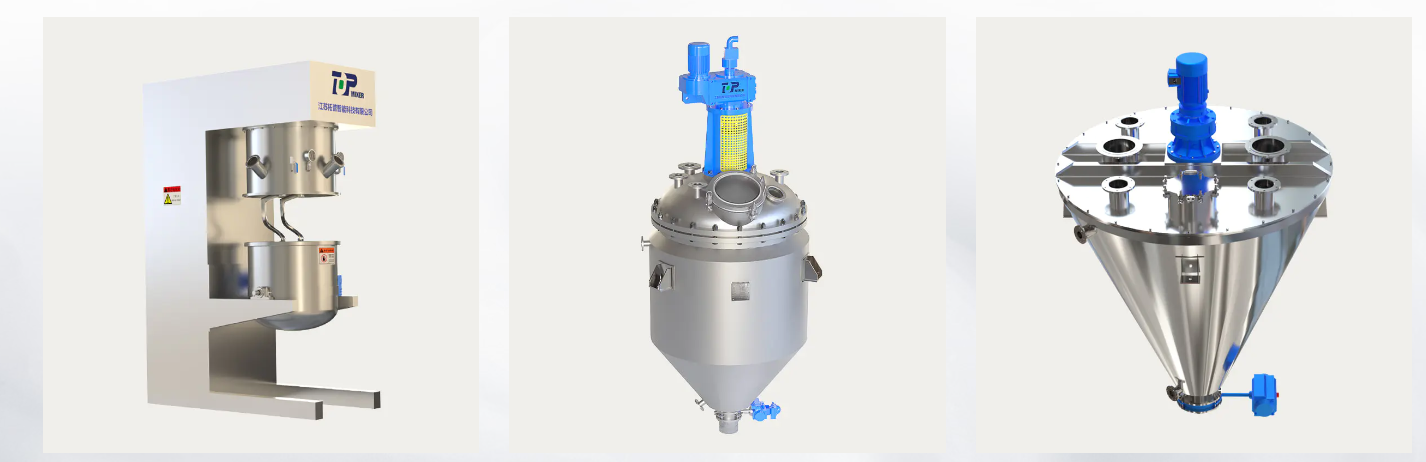
When a pilot-scale battery formulation moves to production, the first batch usually fails not because of chemistry but because of mixing. A slurry that looked smooth in a 20-liter lab container emerges from a 1,000-liter tank with agglomerates, entrapped air, and a viscosity that drifts from batch to batch. The root cause is almost always an equipment mismatch: the powder is processed with machinery not designed for its particle size, viscosity, or shear sensitivity. This article explains how battery powder processing and mixing equipment is selected in industrial practice, what happens at each process stage, and which specifications matter most before you commit capital to a production line.
What Battery Powder Processing and Mixing Involves
Battery manufacturing separates into two fundamentally different operations: dry powder processing and wet slurry mixing. Dry processing covers receiving, storing, conveying, and blending the active material (NCM, LFP, graphite, silicon-carbon composites), conductive carbon, and binder powders. Wet mixing starts when solvent (NMP or water) is added and continues through wetting, dispersion, kneading, and de-aeration until the slurry is ready for coating.
The conclusion that holds across every successful line is simple: dry blending sets the starting distribution of components, while wet mixing determines the final dispersion quality. Neither stage can fully compensate for a poor job in the other.
- Dry blending: homogenize powder components before solvent addition; a common target is an RSD below 5% for conductive carbon and binder distribution.
- Wetting: introduce solvent so that liquid replaces air at particle surfaces; wetting quality decides how fast agglomerates break down.
- Dispersion: apply shear to reduce agglomerates toward primary particles; final fineness is usually checked with a Hegman gauge.
- De-aeration: remove bubbles under vacuum; trapped air causes pinholes and porosity after coating.
- Final adjustment: add solvent or binder solution to reach the coating viscosity and solids content.
These operations rarely happen in one machine unless the equipment is specifically designed as a combined process unit.
| Stage | Main Objective | Typical Equipment | Most Common Risk |
|---|---|---|---|
| Dry blending | Uniform powder composition | Ribbon blender, conical mixer | Segregation after blending |
| Wetting | Solvent penetration into powder | Planetary mixer, disperser | Lumps and dry pockets |
| Dispersion | Break agglomerates | High-speed disperser, rotor-stator | Damage to active-material particles |
| De-aeration | Remove bubbles | Vacuum planetary mixer | Incomplete vacuum seal |
| Final adjustment | Target viscosity and solids content | Mix vessel with sampling | Batch-to-batch drift |
Matching Equipment to Each Process Stage
Define the duty before choosing the machine. Viscosity, shear requirement, vacuum level, and batch size each point to a different class of battery powder processing and mixing equipment.
Dry powder blending: ribbon and conical mixers
For pre-blending active material with conductive carbon and dry binder, a ribbon blender or a conical mixer is the practical default because it exposes a large powder surface to gentle turnover without destroying particle shape. A V-type vacuum ribbon mixer adds vacuum, which limits moisture pickup for hygroscopic powders. Production practice shows that 15 to 30 minutes of blending is usually enough to reach an RSD below 5% for well-dosed additives. What matters at purchase time is the discharge design, the filling ratio, and how easily the machine can be cleaned between batches.
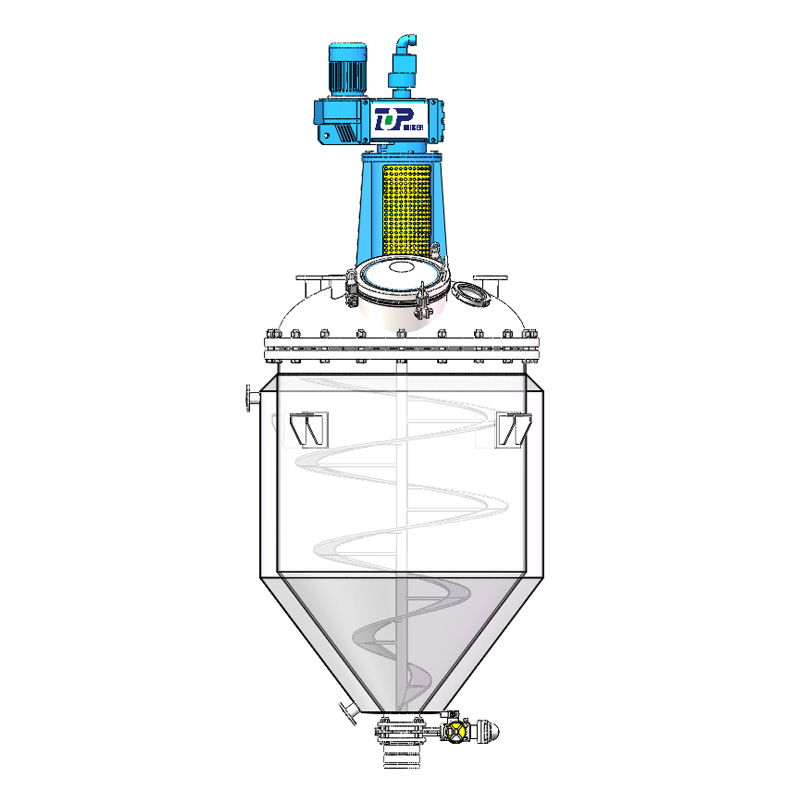 TOPH2031 Series V-Type Vacuum Ribbon MixerThis mixer combines V-type vacuum blending with a ribbon design, offering gentle powder turnover, low moisture pickup, and efficient discharge, making it a reliable pre-blending solution for hygroscopic battery materials.View Product →
High-viscosity slurry mixing: vacuum double planetary mixers
Cathode slurries in NMP commonly reach 5,000 to 50,000 mPa·s, and high-loading formulations exceed 100,000 mPa·s. At that consistency, a conventional top-entry agitator creates a moving channel around the shaft while dead zones remain at the wall. A double planetary mixer turns two stirrers around the tank while they also rotate on their own axes, continuously re-orienting the flow and forcing every portion of the slurry through the blades. Combined with a vacuum cover and wall scraper, this is the configuration most production lines use for final dispersion of NCM and LFP slurries.
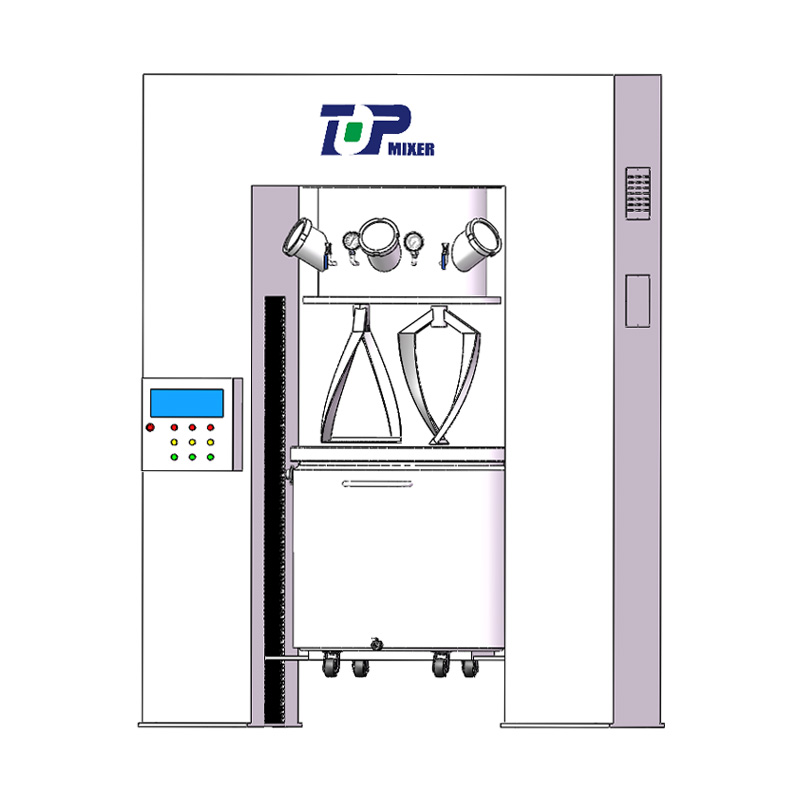 TOPH2014 Series LGXJ Industrial Double Planetary MixerDesigned for high-viscosity slurries up to 3,000,000 cP, this industrial double planetary mixer features dual stirrers and a high-speed dispersion shaft, making it a production-grade choice for final dispersion of NCM and LFP battery slurries.View Product →
Dispersion and fineness control: high-speed dispersers
Not every slurry needs planetary kneading. Water-based anode slurries at 2,000 to 5,000 mPa·s are often dispersed successfully with a high-speed disperser, where a serrated blade generates high shear at its rim. A disperser is also useful as a premix step before the planetary cycle, wetting the powder quickly. The practical rule: if the material is shear-sensitive and the target fineness is reached in minutes, use a disperser; if the material is more viscous and needs longer residence time under vacuum, use a planetary machine.
Dispersion curves compare a vacuum double planetary mixer with a conventional single-shaft agitator for the same NCM formulation; values represent typical agglomerate size D50 during mixing.
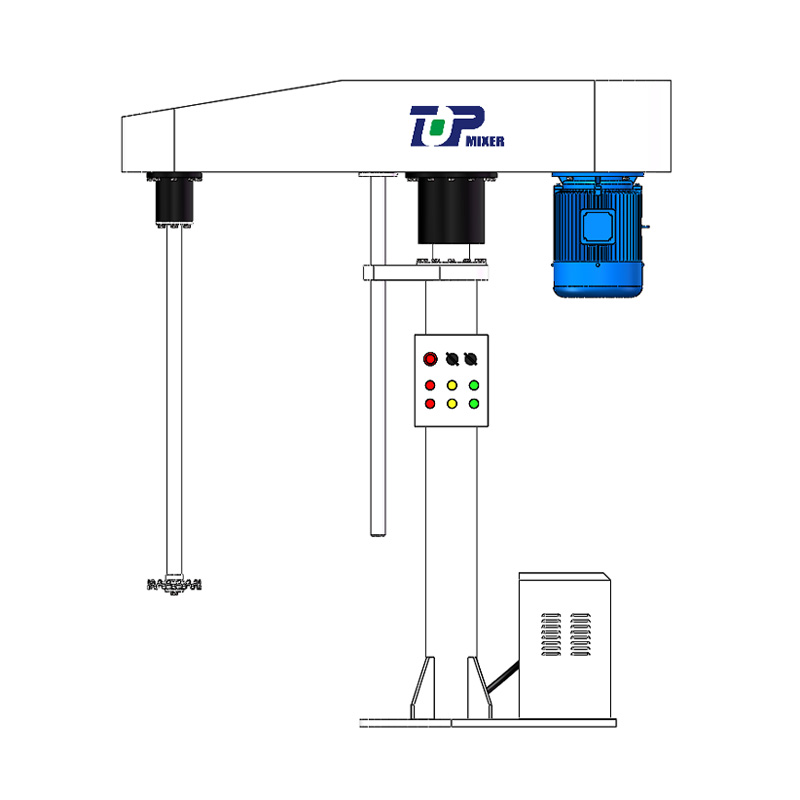 TOPH51 Series FL High Speed DisperserThis high-speed disperser handles liquid and solid-liquid materials with minimal air absorption, enabling quick dissolving and fine particle dispersion across coatings, dyes, pigments, and adhesives, complementing planetary mixers for lower-viscosity premix steps.View Product →
Typical viscosity windows at a glance
The chart below places typical battery slurry families on a logarithmic scale because viscosity spans several orders of magnitude.
Viscosity values are typical production ranges for battery slurry systems, measured at low-shear reference conditions.
Specifications That Decide the Purchase
In practice, the budget is rarely the deciding factor; specifications that look minor during negotiation become hard failures during commissioning. Four checkpoints deserve attention in every RFQ.
| Specification | Why It Matters | Suggested Verification |
|---|---|---|
| Vacuum level and leak rate | Residual air creates pinhole defects in coated electrodes. | Request the guaranteed absolute pressure and pump-down time for the full batch. |
| Viscosity rating | Under-rated motors stall or overheat during high-load wetting. | Ask for the torque curve, not just motor power in kW. |
| Contact material | Metal contamination reduces cell safety. | Specify 316L stainless steel and confirm surface finish, for example Ra below 0.8 µm. |
| Seal type | Solvent leakage or water ingress destroys slurry quality. | Confirm mechanical face seals or magnetic couplings for closed containment. |
For lines that scale from pilot to production, matching the flow field is just as important as matching the vessel volume. Many suppliers use computational fluid dynamics (CFD) analysis to predict velocity profiles, dead zones, and shear distribution before fabrication; the same tool supports scale-up when the production vessel is several times larger than the pilot unit.
When evaluating suppliers for a new battery material plant, ask for references from installations running similar formulations. A useful starting point is to review how mixing equipment performs in documented lithium battery industry project lines, because slurry recipes differ significantly between battery makers.
Anatomy of a Vacuum Planetary Mixer
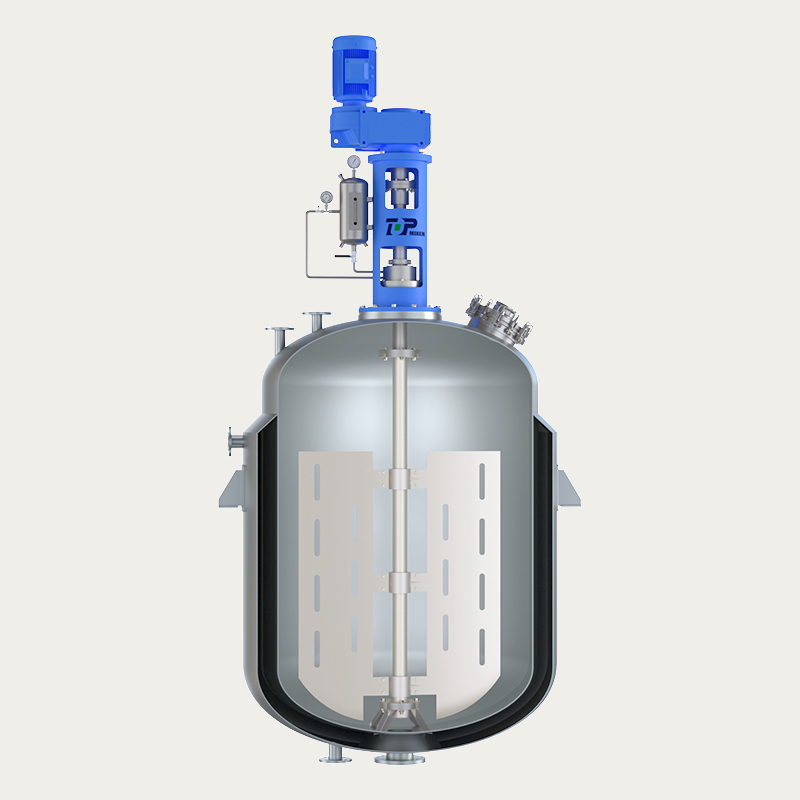
The diagram below shows a typical vacuum double planetary mixer for high-viscosity battery slurries. Comparing the component layout makes it easier to read quotations, because suppliers differ mainly in drive arrangement, scraper design, and vacuum seal quality.
- Vacuum cover
- Vacuum and powder charging port
- Dual planetary drive shafts
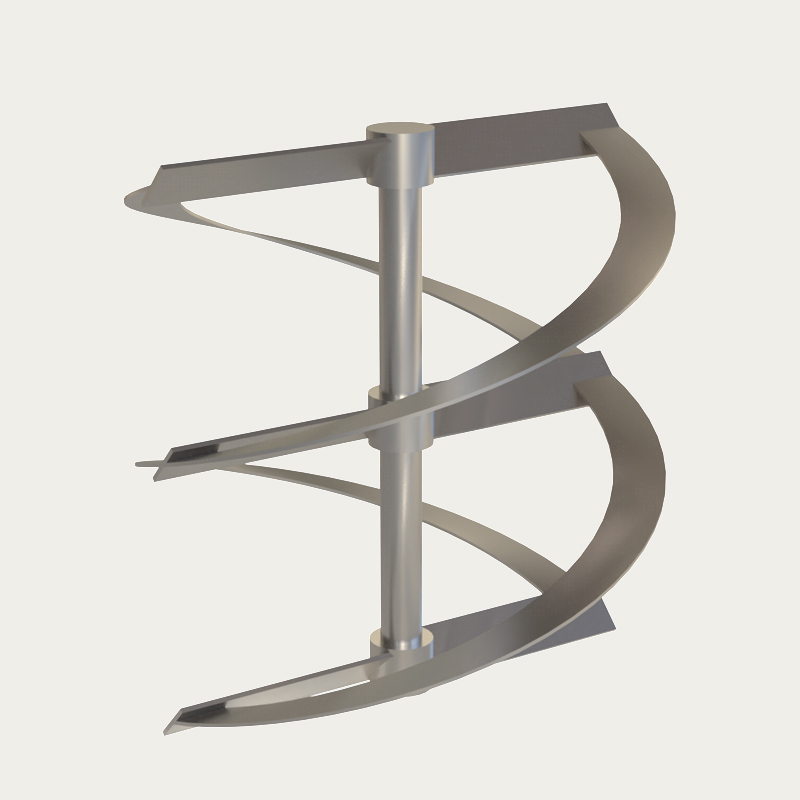
- Frame-type paddles
- Wall scraper
- Jacketed vessel body
- Bottom discharge valve
The two shafts rotate both around the vessel center and on their own axes. That dual motion keeps a 100,000 mPa·s slurry moving instead of rotating as a single mass.
A Practical Selection Checklist
Use this list while screening battery powder processing and mixing equipment; it saves time for both the buyer and the supplier.
- Define the starting powder: bulk density, particle size D50, moisture sensitivity, and angle of repose.
- Define the slurry end point: target viscosity, solids content, fineness, and temperature limit.
- Confirm the duty at the viscosity peak during wetting, not at the average viscosity of the final slurry.
- Check vacuum capability and whether the seal design contains solvent vapor.
- Verify cleaning access for fast product changeover, especially when switching cathode chemistries.
- Request scale-up data from a pilot machine if the production volume is new to your plant.
Frequently Asked Questions
Quick answers to the questions that come up most often in battery slurry mixing projects.
Q1. What equipment is used for battery powder processing and mixing?
A. A typical line combines dry blending equipment such as ribbon or conical mixers with vacuum double planetary mixers, high-speed dispersers, and homogenizers for wet slurry preparation. The exact set depends on the slurry viscosity and fineness target.
Q2. What is the best mixer for high-viscosity battery slurry?
A. Vacuum double planetary mixers are the most common choice for cathode slurries above 10,000 mPa·s because they move the whole volume, scrape the walls, and de-aerate in one process.
Q3. Why is vacuum mixing important for lithium battery slurry?
A. Air bubbles trapped during wetting create pinholes in coated electrodes after drying, lowering capacity and creating safety risks. Vacuum mixing removes these bubbles before coating.
Q4. Can one mixer do both dry powder blending and slurry mixing?
A. Some vacuum planetary mixers can add dry powders directly under vacuum, but dedicated dry blenders are faster and more hygienic for powder-only tasks. Most production lines still use separate equipment for the two stages.
Q5. How do I choose between a double planetary mixer and a high-shear disperser?
A. Use a disperser for low-to-medium viscosity slurries that reach their fineness target in minutes, and a planetary mixer for high-viscosity, shear-sensitive formulations that need longer residence time and vacuum.
Q6. What causes agglomerates in battery slurry?
A. Agglomerates appear when powder is added too fast, when blade speed is too low for wetting, or when moisture is present in the dry blend. Slower powder addition, higher rim speed, and vacuum-assisted mixing reduce them.


- No. 118, Chuangye Road, Jieshou Town, Gaoyou City, Yangzhou, Jiangsu Province, China
- [email protected]
- Landline: +86-0510-83383966 +86-0510-83390667
- Telphone: +86-0510-83390667
- Mr. Chen: +86-18061519769 Mr. Xu: +86-13706183972
- Mr. Lu: +86-18915337056
- Product Link
- Top-Entry Mixer
- Bottom-Entry Mixer
- Side-Entry Mixer
- SIGN UP
- Sign up to be the first to find out the latest news from Top Intelligent Technology
- Subscribe

