

 English
 日本語
日本語 русский


Types of Mixers in Food Industry: Choosing the Right Blending Equipment
Content
- 1 Why the Food Industry Classifies Mixers by Material State
- 2 Main Types of Mixers in the Food Industry
- 2.1 Ribbon Blenders for Dry Powders and Granules
- 2.2 Paddle Mixers for Gentle Blending
- 2.3 Tumbling Blenders: Double-Cone and V-Type
- 2.4 Top-Entry and Side-Entry Impeller Mixers for Liquids
- 2.5 High-Shear Mixers and Homogenizers for Emulsions
- 2.6 Planetary Mixers for High-Viscosity Pastes
- 2.7 Vacuum Mixers and Continuous Mixers for Specialized Duty
- 3 How to Select: Viscosity, Shear, Batch Size, and Hygienic Design
- 4 Putting It Together: Matching Equipment to the Product
- 5 Frequently Asked Questions
- 5.1 Q1: What is the best mixer for the food industry?
- 5.2 Q2: What is the difference between a ribbon blender and a paddle mixer?
- 5.3 Q3: Can the same mixer handle low and high viscosity food products?
- 5.4 Q4: What does a homogenizer do in food processing?
- 5.5 Q5: Why are vacuum mixers used in food production?
- 5.6 Q6: What is the typical mixing time for food mixers?
A food plant planning to move from a single liquid filling line into dry seasoning blends and high-viscosity spreads quickly faces a practical limit: one mixer cannot serve all three product states. The same dilemma appears across bakeries, sauce producers, spice packers and confectionery factories. Equipment buyers and process engineers ask the same fundamental question: which family of mixers fits the intended product, viscosity and throughput? This guide classifies the main types of mixers in the food industry, explains how each type works, and lays out the screening criteria you should apply before requesting a quotation.
Why the Food Industry Classifies Mixers by Material State
Start with the material, not the machine. Most food mixing failures come from selecting a machine class that does not match the product state. The food industry groups mixing tasks into three broad material states: dry free-flowing solids, low to medium viscosity liquids, and high-viscosity pastes or sticky semi-solids. A ribbon blender cannot emulsify a vinaigrette, and a high-shear rotor-stator can smash a breakfast cereal into crumbs. So the first screen is physical state, and the second is the texture target.
- Dry powders and granules: ribbon blenders, paddle mixers, double-cone and V-type blenders.
- Low to medium viscosity liquids: top-entry, side-entry and bottom-entry impeller mixers.
- High-viscosity pastes and doughs: planetary, screw and sigma-blade mixers.
- Liquid-liquid emulsions: high-shear mixers and homogenizers.
Main Types of Mixers in the Food Industry
Ribbon Blenders for Dry Powders and Granules
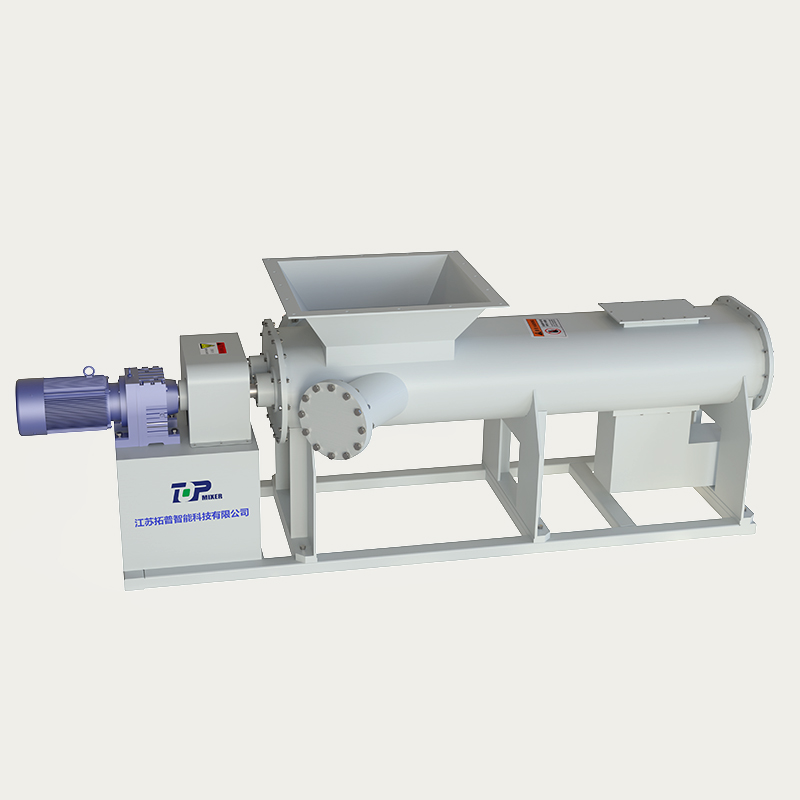
A ribbon blender uses a U-shaped trough and a double helical ribbon. The outer ribbon pushes material in one direction while the inner ribbon returns it in the opposite direction, producing fast convective blending. Typical batch times are 3 to 10 minutes depending on the recipe. Flour blends, spices, soup bases, protein powders and dry sauce premixes are standard duties. For this task, a U-shaped ribbon mixer is a proven starting point because it combines short cycles with easy access for cleaning and inspection.
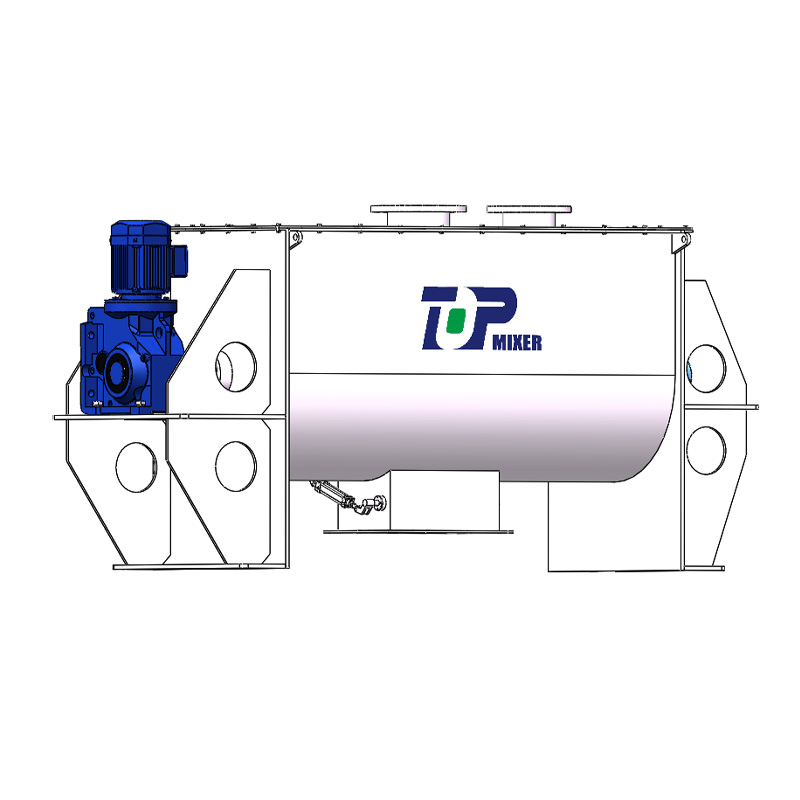 TOPH41 Series U-Shaped Ribbon Mixer Manufacturers, OEM suppliers - Jiangsu Top IJiangsu Top Intelligent Technology Co., Ltd is ChinaTOPH41 Series U-Shaped Ribbon Mixer manufacturers and suppliers,provide OEM wholesale...View Product →
Paddle Mixers for Gentle Blending
Paddle mixers mount flat or pitched blades on a horizontal shaft and rotate at lower tip speeds than ribbon blenders. They are the preferred choice when whole kernels, dried fruit pieces or coated snack pellets must survive the process intact. The gentle lift-and-fold action is also common for seasoning transfer onto fried snacks.
Tumbling Blenders: Double-Cone and V-Type
Double-cone and V-type blenders work on diffusion: the rotating vessel carries particles upward, gravity lets them cascade across the center, and each turnover re-distributes the batch. Because there is no mechanical blade impact, these machines suit free-flowing powders that need high batch-to-batch uniformity, such as vitamin premixes, instant mix powders and spice blends.
Top-Entry and Side-Entry Impeller Mixers for Liquids
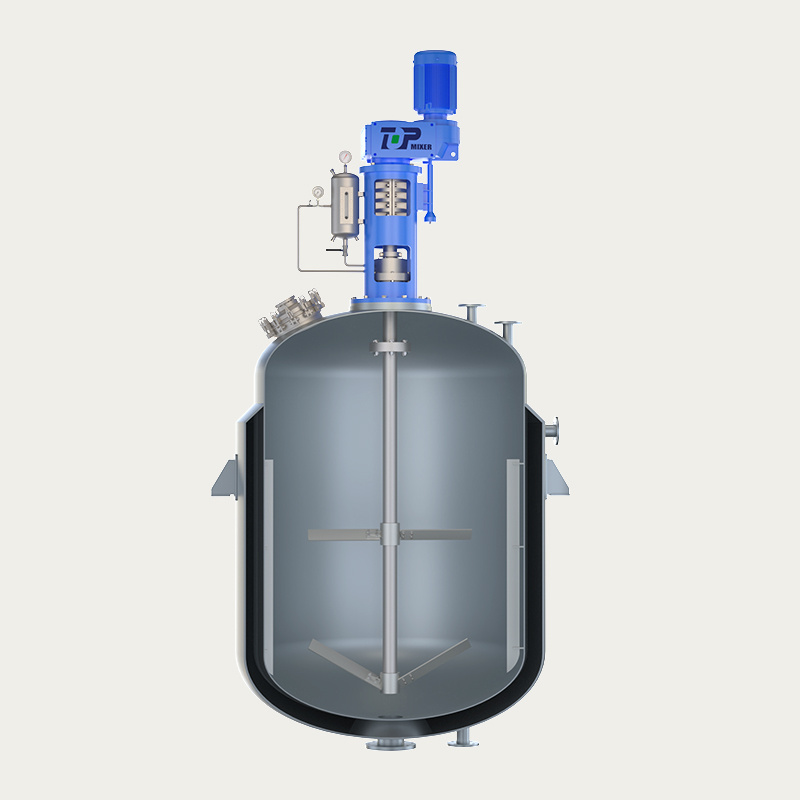
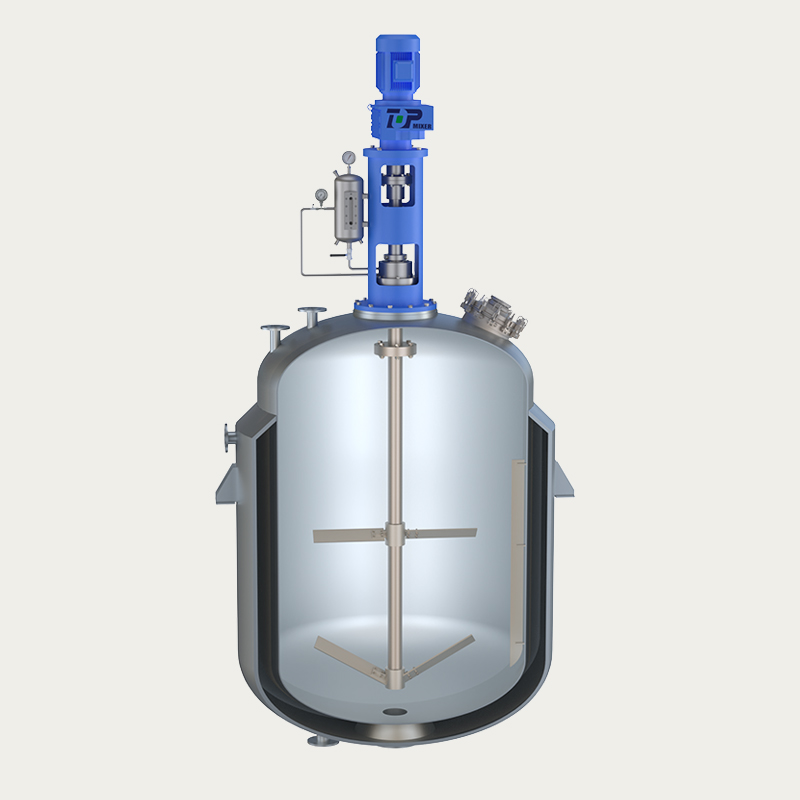
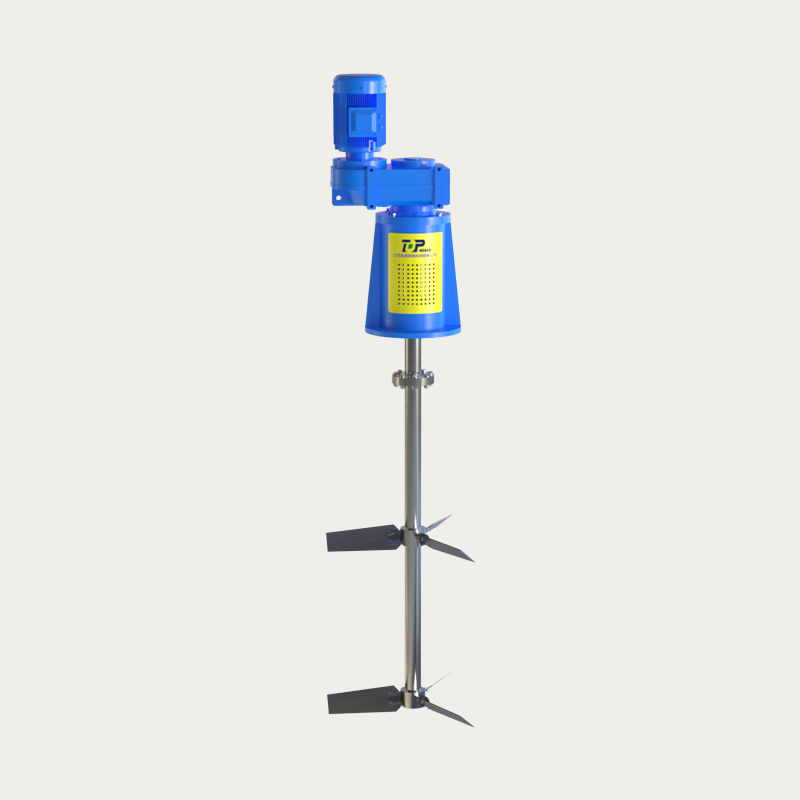
Low to medium viscosity liquids—sugar syrups, brines, fruit juice concentrates and stabilizer solutions—are mixed in tanks with top-entry, side-entry or bottom-entry impeller mixers. Top-entry is the most common arrangement for atmospheric tanks because the drive is accessible for maintenance and the shaft is short. Axial-flow turbines move liquid from top to bottom; radial-flow designs increase turbulence near the wall. For food tanks, a top-entry mixer with a hygienic mechanical seal prevents leakage and keeps the tank top easy to clean.
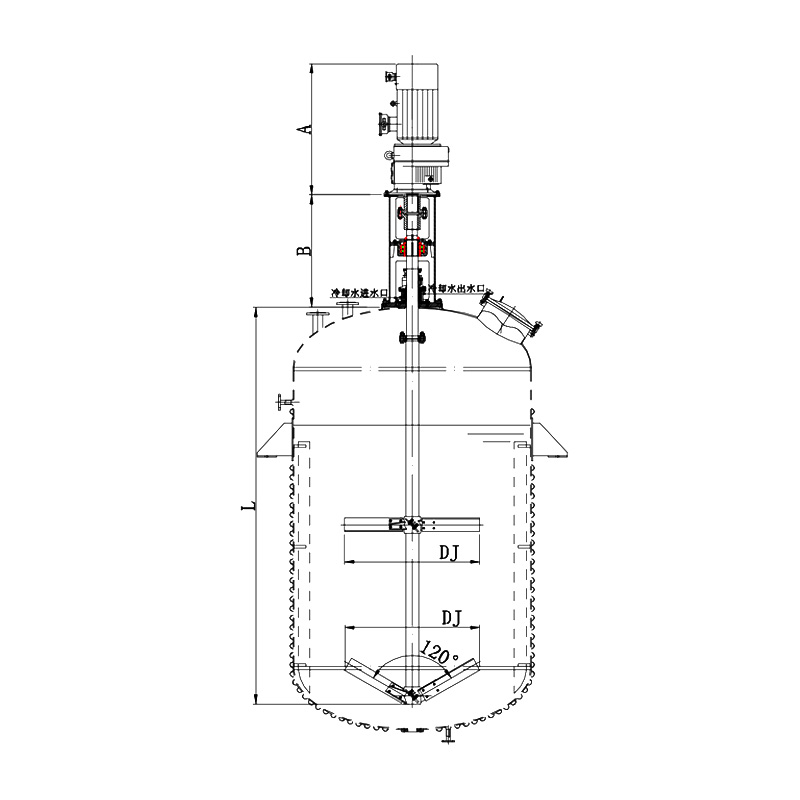 TOPA001DR Top-Entry Mixer Manufacturers, OEM suppliers - Jiangsu Top IntelligentJiangsu Top Intelligent Technology Co., Ltd is ChinaTOPA001DR Top-Entry Mixer manufacturers and suppliers,provide OEM wholesale customiza...View Product →
High-Shear Mixers and Homogenizers for Emulsions
High-shear mixers force product through the narrow gap between a high-speed rotor and a stationary stator. The intense hydraulic shear breaks fat droplets and solid agglomerates down to micrometer size, producing the stable texture of mayonnaise, salad dressing, tomato sauce and cream liqueur. When droplet size and mouthfeel are brand-critical, a separate homogenizer is often added after the main mixer.
Planetary Mixers for High-Viscosity Pastes
Planetary mixers carry two or three agitators that rotate on their own axes while orbiting the mixing tank, so every part of the vessel is swept during each revolution. This sweeping action lets them handle stiff pastes—dough, meat filling, jam, caramel and nut butter—that a shaft-driven impeller cannot pump. A double-planetary industrial mixer can process viscosities into the millions of centipoise range and is often used under vacuum to de-aerate the product.
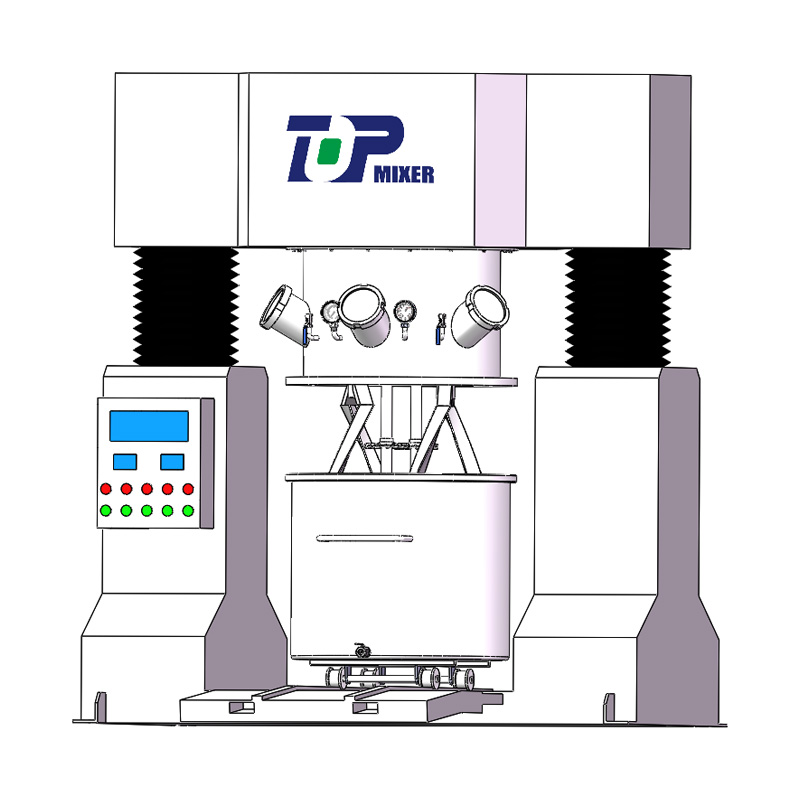 TOPH2013 Series GXJ Industrial Double Planetary Mixer Manufacturers, OEM supplieJiangsu Top Intelligent Technology Co., Ltd is ChinaTOPH2013 Series GXJ Industrial Double Planetary Mixer manufacturers and suppliers,pro...View Product →
Vacuum Mixers and Continuous Mixers for Specialized Duty
Vacuum mixers combine mixing with de-aeration. Removing entrapped air reduces oxidation, improves color and texture, and prevents foam in products such as processed cheese, chocolate and baby food. Continuous mixers take the opposite approach: product flows steadily through a stationary housing while rotating pins or paddles mix it. Cook-and-cool lines for soups, starches and sauces use continuous mixers for high-volume, single-recipe production.
How to Select: Viscosity, Shear, Batch Size, and Hygienic Design
Use four screening criteria in order. Viscosity sets the mechanical limit: an impeller cannot create flow in a paste, and a planetary mixer is oversized for water-thin juice. Shear sensitivity decides blade speed and gap geometry—emulsions need intense shear, while suspensions and coated solids need gentle turnover. Batch size determines the machine volume and whether batch or continuous operation is justified. Hygienic design determines if the mixer can be cleaned and validated under your food safety program.
Screening ranges based on food engineering mixer selection guides; verify with pilot trials.
| Mixer type | Best suited for | Typical viscosity | Shear level | Food example |
|---|---|---|---|---|
| Ribbon blender | Dry powders, granules | 1 - 100,000 cP | Low | Flour blends, spices, soup base |
| Paddle mixer | Fragile coated solids | 1 - 300,000 cP | Low to moderate | Cereal, dried fruit, seasoned nuts |
| Top-entry impeller | Low and medium liquids | 1 - 10,000 cP | Moderate | Syrups, brines, juice |
| High-shear / homogenizer | Emulsions, smooth textures | 1 - 30,000 cP | High | Dressings, mayonnaise, milk |
| Planetary mixer | High-viscosity pastes | 1,000 - 6,000,000 cP | Moderate to high | Dough, jam, caramel, meat paste |
The wetted path matters as much as the motor. Food-contact surfaces must be polished, crevice-free and CIP/SIP compatible; elastomers must meet FDA food-contact requirements; and the shaft seal is the most common contamination point. This is why CFD flow analysis is used to verify both mixing patterns and cleaning coverage before a mixer is built.
Once the product state points you toward two or three candidates, compare them on non-mechanical criteria. The radar chart below scores three families on shear control, viscosity range, batch flexibility, hygienic design and cost efficiency. Ribbon blenders lead on cost; high-shear machines lead on shear control; planetary mixers lead on viscosity range and flexibility.
Relative scores from 1 to 5 for initial screening after the viscosity match is made.
Putting It Together: Matching Equipment to the Product
Consider a medium-size food company that makes fruit juice concentrate, dry seasoning mixes, and a new line of caramel spread. The juice lines run in 5,000 L tanks with top-entry impeller mixers and baffles to prevent vortexing. The seasoning room batches 300 kg blends in a ribbon blender. The caramel line needs a double-planetary mixer that can knead a sticky multi-million-cP paste while the vacuum hood removes air during filling. Each machine serves a different physical state; no single unit covers all three.
The isometric drawing below shows the main elements of a top-entry food mixer in a process tank.
Components shown schematically; seal type and impeller design vary by duty.
Baffles prevent vortex formation and improve top-to-bottom turnover, the impeller position controls the flow pattern, and the bottom discharge valve allows full drainage during CIP. Utilities such as motor power, shaft length and seal type are then sized to the tank geometry and the target mixing time. For reference installations across dairy, beverage, sauce and bakery lines, see our food-industry mixing project references.
Frequently Asked Questions
Q1: What is the best mixer for the food industry?
There is no single best mixer. Select by product state: ribbon blenders for dry powders, top-entry impeller mixers for liquids, planetary mixers for high-viscosity pastes, and high-shear mixers for emulsions.
Q2: What is the difference between a ribbon blender and a paddle mixer?
Both are horizontal dry-solid mixers, but a ribbon blender uses a helical ribbon for fast convective blending, typically in 3 to 10 minutes, while a paddle mixer runs at lower tip speed and gives gentler treatment to fragile or coated particles.
Q3: Can the same mixer handle low and high viscosity food products?
Generally no. Impellers lose pumping capacity in pastes, and planetary agitators are inefficient in thin liquids. Dual-shaft mixers extend the operating window, but the viscosity range still defines the equipment family.
Q4: What does a homogenizer do in food processing?
A homogenizer forces the product through a high-pressure or high-shear gap to reduce droplet and particle size, creating stable emulsions and smooth textures in milk, sauces, dressings and juices.
Q5: Why are vacuum mixers used in food production?
Vacuum mixers remove entrapped air during mixing. This limits oxidation, improves texture and reduces foaming in processed cheese, chocolate and sticky confectionery products.
Q6: What is the typical mixing time for food mixers?
Ribbon blenders typically finish in 3 to 10 minutes; planetary mixers take 10 to 30 minutes for high-viscosity batches; high-shear emulsification runs about 5 to 15 minutes. Actual time depends on viscosity, batch size and the final droplet or particle specification.


- No. 118, Chuangye Road, Jieshou Town, Gaoyou City, Yangzhou, Jiangsu Province, China
- [email protected]
- Landline: +86-0510-83383966 +86-0510-83390667
- Telphone: +86-0510-83390667
- Mr. Chen: +86-18061519769 Mr. Xu: +86-13706183972
- Mr. Lu: +86-18915337056
- Product Link
- Top-Entry Mixer
- Bottom-Entry Mixer
- Side-Entry Mixer
- SIGN UP
- Sign up to be the first to find out the latest news from Top Intelligent Technology
- Subscribe

